

Spend enough time around commercial solar projects, and you’ll notice something interesting.
When contractors talk about mounting systems after a project is complete, they rarely focus on the components that performed exactly as expected. The conversations usually revolve around the systems that created extra work, required field modifications, or became difficult to service years later.
That’s why experienced installers tend to evaluate rail systems differently from someone reading a specification sheet for the first time. Load ratings matter. Engineering data matters.
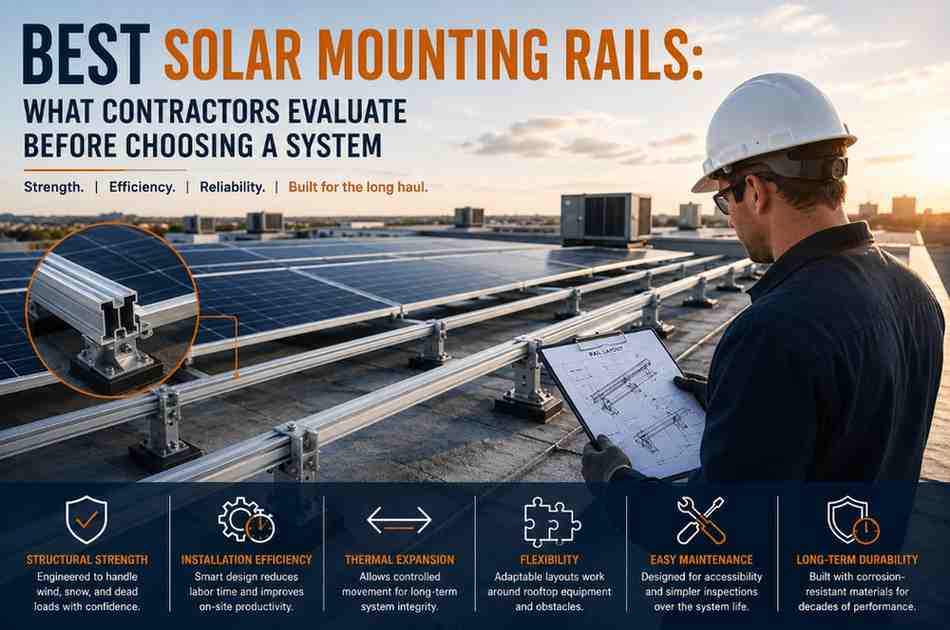
But the best solar mounting rails are often those that balance structural strength, installation efficiency, and long-term reliability in real-world conditions.
For EPC firms, project managers, solar contractors, and commercial roofing professionals, those factors can directly impact project costs, labor requirements, and long-term system performance.
At a basic level, every rail system serves the same purpose.
It supports photovoltaic modules and transfers loads from the solar array into the building structure. The differences start to appear when contractors evaluate how a system performs beyond minimum engineering requirements.
The best solar mounting rails are typically assessed on:
These factors often influence product selection just as much as published load ratings.
A solar rail system is exposed to environmental forces throughout its service life.
Wind uplift, snow loading, thermal cycling, and daily weather exposure all place demands on the mounting structure.
While engineering calculations determine whether a system meets code requirements, contractors often think further ahead.
They want to know how the rail system will perform after years of seasonal temperature fluctuations, rooftop maintenance, and exposure to weather.
A well-designed rail system helps maintain:
This becomes especially important on commercial rooftop solar projects where longer rail runs and larger array footprints create additional loading considerations.
Some of the most valuable lessons about rail performance come during reroofing work.
When older photovoltaic systems are removed, installers get a clear look at how the mounting system handled years of real-world conditions.
Common findings include:
These observations help explain why experienced contractors often evaluate long-term durability as carefully as initial engineering specifications.
A rail system may perform well during installation. The true test is how it performs ten or fifteen years later.
A rail system can meet structural requirements and still create challenges in the field.
That’s one reason installation efficiency has become a major consideration when comparing the best solar mounting rails.
Contractors often evaluate:
Can crews establish straight rows of modules without constant adjustments?
Are rail splice connections simple and repeatable?
Does the system reduce unnecessary installation complexity?
Can the system work efficiently with common attachment and flashing solutions?
Small efficiencies may seem minor on paper, but across a large commercial array, they can significantly influence labor costs and project schedules.
Many buyers initially focus on engineering tables and allowable spans.
Those numbers matter, but they don’t tell the entire story.
Experienced project teams also consider:
For example, thermal expansion becomes increasingly important as array sizes grow. Rails naturally expand and contract with temperature changes, and a system that accommodates that movement effectively can help reduce stress throughout the mounting assembly.
Likewise, organized cable routing and mounting system design both play important roles in long-term serviceability. When evaluating options, many contractors consider how systems such as RT Rail integrate with rooftop attachments, module layouts, and ongoing maintenance requirements to create cleaner, easier-to-manage installations.
When evaluating RT Rail, many contractors focus on the balance between strength and installation efficiency.
Rather than viewing the rail as an isolated component, project teams often evaluate how the system interacts with:
This broader perspective reflects how mounting systems are evaluated in real-world commercial projects.
A rail system isn’t judged solely by how it performs on installation day. It’s judged by how well it supports the photovoltaic system throughout its lifecycle.
Beyond product specifications, industry research continues to emphasize the importance of structural design, environmental loading considerations, and long-term system reliability. Research from the National Renewable Energy Laboratory (NREL) highlights how mounting system performance contributes to the overall durability and effectiveness of photovoltaic (PV) installations, particularly in commercial applications.
Before specifying a product, many contractors ask:
The answers often reveal meaningful differences between rail systems that initially appear very similar.
The best solar mounting rails aren’t necessarily the systems with the highest numbers on a specification sheet.
They’re the systems that continue to perform after years of weather exposure, thermal movement, rooftop maintenance, and changing project demands.
Contractors who regularly work on commercial solar projects understand that long-term reliability often comes down to details that aren’t always obvious during initial product comparisons.
Strength matters. Installation efficiency matters. But the rail systems that stand out over time are the ones designed to support both.
The best solar mounting rails typically balance structural strength, installation efficiency, corrosion resistance, and long-term durability while accommodating real-world environmental conditions.
Load ratings provide important engineering information, but contractors also evaluate installation efficiency, maintenance requirements, roof compatibility, and long-term performance.
Rails naturally expand and contract as temperatures change. Systems designed to accommodate thermal movement can help reduce stress on attachments, connections, and other mounting components.
EPC firms often evaluate structural performance, installation workflow, engineering support, compatibility, and lifecycle maintenance considerations.
Yes. Rail layout, attachment placement, and system accessibility can influence how efficiently solar systems are removed and reinstalled during reroofing work.
Absolutely. Rail design affects accessibility, alignment, attachment conditions, and overall serviceability throughout the life of the solar installation.

© 2025 Crivva - Hosted by Airy Hosting Managed Website Hosting.