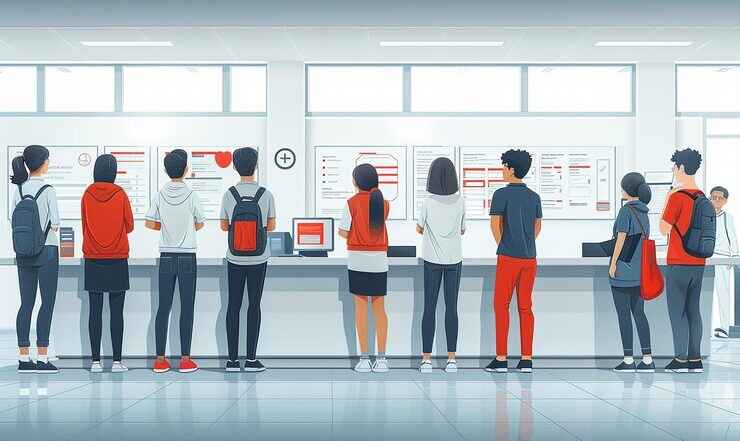
Customer experience has become one of the strongest factors that decide whether a business grows or loses customers. People today expect faster service, clear communication, and minimal waiting time. Long queues and unmanaged crowds often lead to frustration and poor service perception. This is why many organizations are adopting queue management system software to modernize how they handle customer flow and service delivery.
In 2026, businesses across healthcare, banking, retail, government services, and telecom are using digital systems to replace traditional waiting lines. These solutions are designed to improve efficiency, reduce crowding, and create a smoother customer journey from entry to service completion.
A queue management system is a digital solution that organizes and controls customer waiting lines in an efficient way. Instead of physical queues where people stand and wait without updates, the system allows businesses to manage customer flow using tokens, mobile apps, kiosks, and display screens.
A modern system helps businesses:
Unlike traditional methods, this approach brings transparency and structure to service environments.
The process behind a digital queue system is simple but highly effective. It focuses on organizing customers and improving service speed.
Customers can join the queue using a kiosk, mobile application, website, or reception desk.
A digital token or number is assigned automatically, which determines the customer’s position in line.
Instead of standing in one place, customers receive updates through SMS, mobile notifications, or display screens.
When it is their turn, customers are guided to the appropriate counter or service desk.
Managers track waiting times, staff performance, and customer flow using dashboards.
This structured system reduces confusion and creates a smoother experience for both staff and customers.
Modern systems come with several advanced features designed to improve efficiency and convenience.
Customers do not need to physically wait in line. They can join remotely and arrive when their turn approaches.
Many businesses now allow customers to book time slots in advance, reducing crowding and improving planning.
Updates are sent automatically so customers always know their status in the queue.
The system directs customers to the right department or service desk based on their needs.
Businesses can analyze peak hours, average waiting times, and staff efficiency.
Large organizations can manage multiple branches from a single dashboard.
Customers feel more comfortable when they are informed and not left waiting without updates.
By organizing flow efficiently, businesses can significantly reduce unnecessary delays.
Employees spend less time managing crowds and more time focusing on service quality.
Managers get a clear view of daily operations and can make faster decisions.
Waiting areas become less congested, improving safety and comfort.
Hospitals and clinics use digital systems to manage patient flow, reduce waiting room congestion, and prioritize emergency cases.
Banks rely on structured systems to manage counters, customer tokens, and service efficiency.
Retail businesses use queue systems to manage billing counters and improve checkout speed.
Public service centers use these systems to handle large crowds more efficiently and transparently.
Support centers use queue systems to manage customer complaints and service requests in an organized manner.
Traditional queues are slow, unorganized, and often frustrating for customers. People stand in long lines without knowing how long they will wait, which leads to dissatisfaction.
Digital systems solve this problem by introducing:
This shift is not just about convenience—it is about improving business performance and customer loyalty.
| Feature | Traditional Queue | Digital Queue System |
|---|---|---|
| Waiting Experience | Uncertain | Transparent |
| Customer Updates | None | Real-time alerts |
| Crowd Control | Poor | Organized |
| Staff Efficiency | Low | High |
| Data Tracking | Manual | Automated |
| Customer Satisfaction | Low | High |
The comparison clearly shows why businesses are switching to digital systems.
Selecting the right system depends on several important factors.
The system should be simple for both customers and staff.
It should support business growth without performance issues.
It should connect easily with CRM, billing, and appointment tools.
Cloud-based systems allow remote access and better flexibility.
Detailed analytics help businesses improve decision-making.
Technology has transformed how businesses handle customer flow. Artificial intelligence, automation, and cloud computing are making systems smarter and more efficient.
Modern solutions can:
These advancements help businesses deliver faster and more personalized service experiences.
The future of customer flow management is moving toward fully automated and intelligent systems.
Some emerging trends include:
These innovations aim to remove waiting stress completely and create seamless customer journeys.
Businesses that adopt modern queue systems often experience:
Customer experience is directly linked to business growth, and structured service systems play a major role in achieving that.
It is a digital solution that organizes customer waiting lines and improves service efficiency.
It is widely used in hospitals, banks, retail stores, government offices, and telecom centers.
Yes, it optimizes customer flow and reduces unnecessary delays.
Yes, even small service centers can benefit from better organization and customer experience.
In today’s competitive environment, businesses cannot afford poor customer service experiences. A modern queue system helps organizations improve efficiency, reduce waiting time, and deliver better service quality.
By using advanced digital solutions, companies can create smoother customer journeys and build stronger relationships with their audience. As technology continues to evolve, these systems will become even more intelligent, automated, and essential for business success.

© 2025 Crivva - Hosted by Airy Hosting Managed Website Hosting.