

The prospect of being diagnosed with Arteriovenous Malformation (AVM) is daunting. The complicated web of blood vessels that are abnormal, the possibility of bleeding, and the fear of being in the dark, everything comes together to answer one concern: Will treatment actually succeed? If you or someone else you know is looking into alternatives, knowing the AVM Embolization Success Rate will give you clarity and, most importantly, hope.
A malformation of the arteriovenous system is an abnormal blood vessel that connects veins and arteries, bypassing the capillary network normally. If they occur in the spinal cord or brain, there are serious dangers such as hemorrhage, seizures, and neurological damage.
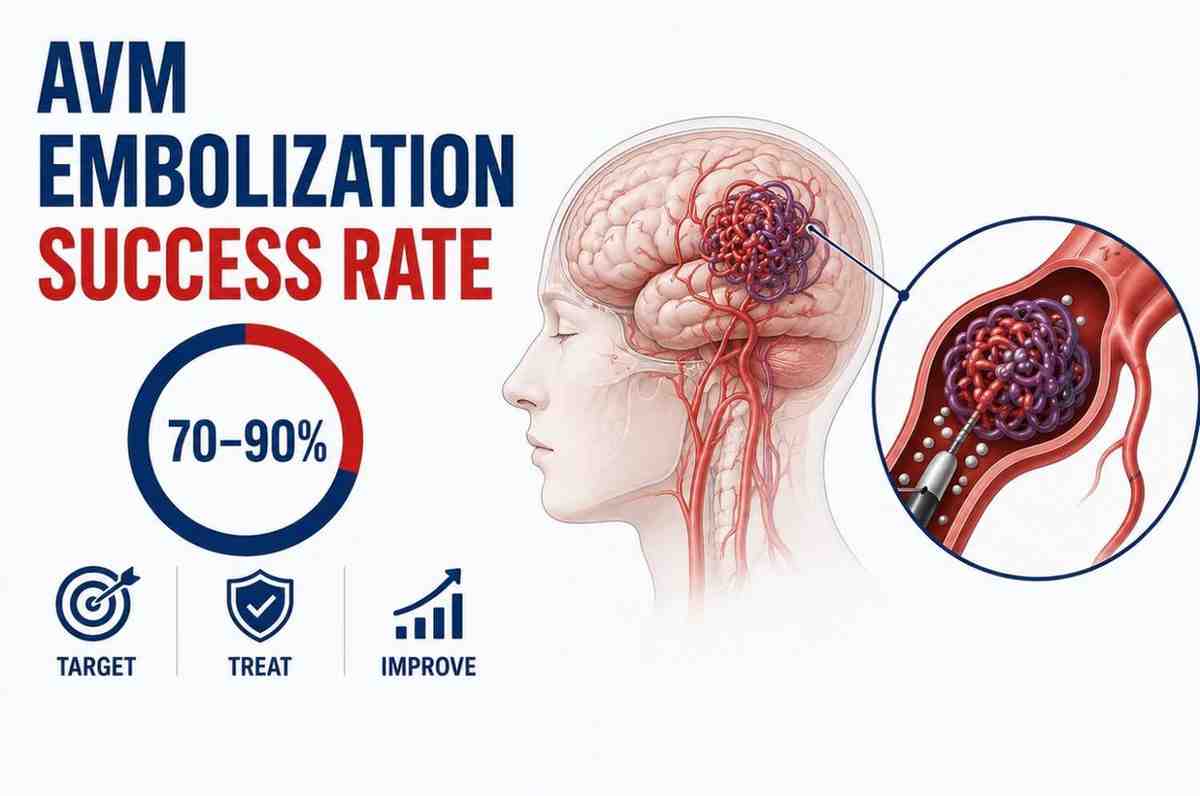
Embolization is a relatively minimally invasive procedure in which a specialist threads an instrument through blood vessels and injects embolic agents (glue, coils, gel, or particles) directly into the AVM. The aim is to decrease blood flow, reduce the malformation, and make it more suitable for radiosurgery or, in certain instances, eliminate it.
One of the major advantages of AVM embolization is that it can target the abnormal blood vessels with remarkable precision while minimizing damage to surrounding healthy tissue. The procedure is performed through a small puncture, avoiding the need for large surgical incisions and often resulting in a shorter recovery period compared to traditional open surgery.
The success of AVM embolization depends on several factors, including the size, location, and complexity of the malformation. Smaller AVMs generally respond more favorably, while larger or deeply located AVMs may require multiple treatment sessions or a combination of therapies. In many cases, embolization serves as an important first step that reduces the risk of bleeding and improves the effectiveness of subsequent treatments.
Patients are typically evaluated using advanced imaging techniques such as MRI, CT scans, and angiography to create a personalized treatment plan. With ongoing advancements in interventional radiology, embolization techniques have become increasingly safe and effective, offering many patients a valuable treatment option and a better quality of life. Understanding how the procedure works can help patients make informed decisions and approach treatment with greater confidence.
Here’s where patients need truthful, straightforward solutions. The AVM embolization rate differs based on the location, size,e and the complexity of the thermal formation, but the data are positive.
Complete obliteration (full elimination) by embolization only occurs in about 10%-20 percent of instances. However, when it is used in a multimodal approach,h when combined with stereotactic or microsurgery radiosurgery, the overall AVM embolization efficiency increases significantly. Studies have reported a combined rate of success of 85-95 percent for lower-grade AVMs.
For more complex, larger AVMs that require staged embolization, these sessions decrease blood flow gradually and make subsequent procedures safer and more efficient. In these instances,s it is the AVM embolization rate to reduce the risk of surgery that is over the 80% mar,k which makes it an important step to prepare for surgery.
What makes embolization so valuable is its capability to focus on deep or elegant brain regions, where surgery on its own has an unacceptably high risk. Interventional neuroradiology has truly changed results for the patients.
Every AVM is alike, nor is every result. A variety of factors directly affect the embolization of the AVM:
The majority of patients are comfortable with embolization. The procedure is done under general anesthesia, usually lasting between two and five minutes. The recovery process in hospitals typically lasts between one and 3 days. A majority of patients return to their normal activity within one week.
The neurologic effects of embolization have been observed in about 5-10% of cases.s Most of them are temporary. More serious complications are more prevalent in centers that specialize in. If you compare these numbers against the normal course for an AVM that is not treated, the risk of hemorrhage per year can be as low as 2 percent, increasing over the course of a lifetime. Treatment is a viable option for the majority of patients.
Following-up imaging using MRI as well as cerebral angiography proves the effectiveness of treatment and orients the subsequent steps. Patients who receive successful combined therapy eventually live their lives in full and unrestricted freedom.
Should you find yourself or someone else you love diagnosed with an AV, M the road ahead can be daunting, but there are plenty of alternatives. The AVM Embolization Success Rate is indeed especially true when it is part of an extensive neurovascular treatment program, which provides patients with an opportunity to feel confident.
Consider a visit to a center with a dedicated neurovascular expert. Talk to your doctor about the exact AVM Embolization Success Rate for your AVM’s degree and the site. Know the treatment plan, whether the embolisation is a separate or preparatory, and what follow-up is expected.
The first step is to be knowledgeable towards confidence. Confidence, when coupled with expert treatment, is what turns an unsettling diagnosis into a tale of healing.

© 2025 Crivva - Hosted by Airy Hosting Managed Website Hosting.