

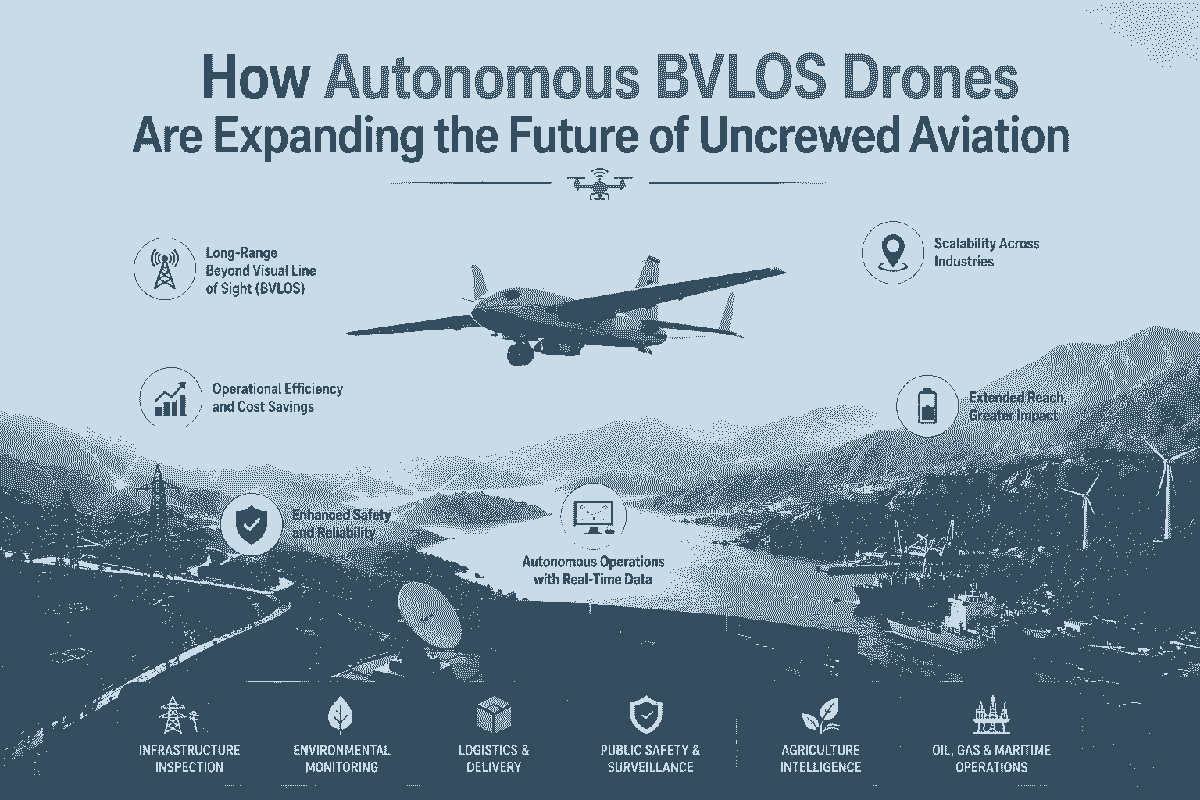
Autonomous Beyond Visual Line of Sight (BVLOS) drones are reshaping the future of uncrewed aviation by enabling aircraft to operate safely over long distances without requiring pilots to maintain direct visual contact. As industries increasingly seek efficient, scalable, and data-driven aerial solutions, BVLOS technology is unlocking new opportunities across logistics, infrastructure inspection, agriculture, emergency response, environmental monitoring, and public safety. Combined with advances in artificial intelligence, autonomous navigation, and communication systems, these drones are becoming an important part of modern aviation ecosystems.
According to a study published by MarkNtel Advisors, detailed insights can be found in the Autonomous BVLOS Drones industry report. The report examines emerging technology trends, evolving regulatory developments, industry applications, and the factors influencing the adoption of autonomous long-range drone operations across global markets.
Traditional drone flights generally require operators to maintain visual contact with the aircraft throughout the mission. BVLOS operations remove this limitation by allowing drones to travel beyond the pilot’s direct line of sight while remaining under safe and controlled operation.
These missions rely on advanced onboard technologies, including autonomous flight planning, obstacle detection, satellite navigation, secure communication links, and real-time data processing. Together, these capabilities enable drones to perform complex operations with minimal human intervention while maintaining operational safety.
As autonomous technologies continue to mature, BVLOS drones are becoming increasingly capable of carrying out longer and more sophisticated missions across diverse environments.
Inspection of critical infrastructure often requires significant time, specialized equipment, and personnel working in hazardous environments. Autonomous BVLOS drones provide a safer and more efficient alternative by inspecting transmission lines, railways, pipelines, highways, telecommunications towers, wind farms, and solar installations.
High-resolution imaging, thermal sensors, and LiDAR technologies enable operators to identify structural issues, vegetation encroachment, equipment faults, and maintenance requirements without interrupting normal operations. This improves inspection efficiency while reducing operational risks and maintenance costs.
Organizations such as the Federal Aviation Administration (FAA) continue to develop regulatory frameworks supporting the safe integration of advanced drone operations into national airspace.
Autonomous BVLOS drones are creating new possibilities for transporting essential supplies across challenging geographic regions. Medical equipment, pharmaceuticals, emergency supplies, and time-sensitive packages can be delivered more efficiently to remote communities where conventional transportation may be limited.
These capabilities are particularly valuable during natural disasters, humanitarian missions, and emergency response situations, where rapid delivery can significantly improve operational effectiveness. As drone technologies become more reliable, organizations are exploring broader commercial logistics applications while working within evolving aviation regulations.
Agriculture is increasingly embracing autonomous aerial technologies to improve productivity and resource management. BVLOS drones enable farmers to monitor large agricultural areas efficiently, collecting detailed information about crop health, irrigation performance, pest activity, and soil conditions.
The resulting data supports precision agriculture practices by helping farmers optimize fertilizer application, irrigation scheduling, and crop protection strategies. Continuous aerial monitoring also enables earlier identification of potential issues, improving decision-making throughout the growing season.
The Food and Agriculture Organization of the United Nations (FAO) continues to promote digital technologies that strengthen sustainable agricultural development and improve resource efficiency.
Artificial intelligence plays a central role in modern BVLOS operations. AI algorithms assist drones in route optimization, obstacle avoidance, object recognition, predictive maintenance, and autonomous decision-making during flight.
Machine learning also improves mission planning by analyzing historical flight data and environmental conditions to increase operational efficiency. As AI capabilities continue advancing, autonomous drones are expected to perform increasingly complex missions with greater accuracy and reliability.
Reliable communication systems remain essential for safe BVLOS operations. Autonomous drones depend on secure data links, satellite navigation, cellular connectivity, and remote command systems to maintain continuous situational awareness throughout each mission.
At the same time, aviation authorities worldwide are developing Unmanned Aircraft System Traffic Management (UTM) solutions that enable drones to safely share airspace with conventional aircraft. Organizations including the International Civil Aviation Organization (ICAO) continue supporting the development of international standards for integrating uncrewed aircraft into global aviation systems.
Autonomous BVLOS drones are expected to become increasingly important as industries continue adopting digital transformation, automation, and intelligent aerial operations. Continued progress in artificial intelligence, communication technologies, navigation systems, and aviation regulations will further expand the practical use of long-range autonomous drone missions.
As governments, enterprises, and technology providers invest in safer and more capable autonomous aviation solutions, BVLOS drones are positioned to support a wide range of commercial, industrial, and public-sector applications while improving efficiency, safety, and operational flexibility across multiple industries.
Autonomous Beyond Visual Line of Sight (BVLOS) drones are redefining what is possible in modern aviation by enabling aircraft to fly safely beyond an operator’s visual range while making intelligent, real-time decisions throughout the mission. Powered by advances in artificial intelligence, satellite navigation, edge computing, and secure communication networks, these drones are moving beyond traditional aerial photography to become critical tools for industries that require long-range, autonomous operations. From delivering medical supplies to remote communities and inspecting thousands of kilometers of power lines to monitoring large-scale farms, supporting disaster response, and enhancing public safety, BVLOS technology is opening entirely new possibilities for uncrewed aviation. As governments establish clearer regulatory frameworks and organizations increasingly embrace automation, autonomous BVLOS drones are emerging as a cornerstone of the next generation of aerial mobility, offering greater operational efficiency, improved safety, lower costs, and access to locations that were previously difficult or impossible to reach.
The evolution of communication technologies is equally important. High-speed 5G networks, satellite connectivity, and advanced Unmanned Aircraft System Traffic Management (UTM) solutions are enabling drones to maintain secure communication links over long distances while safely sharing airspace with conventional aircraft. As aviation authorities continue refining BVLOS regulations and certification frameworks, commercial adoption is expected to accelerate across a wide range of industries.
Looking ahead, autonomous BVLOS drones are poised to become a foundational technology within the broader ecosystem of intelligent aviation. Continued investments in autonomous navigation, AI-driven flight management, battery innovation, detect-and-avoid systems, and regulatory modernization will unlock even more sophisticated applications. From smart cities and critical infrastructure management to environmental monitoring, defense operations, and industrial inspections, BVLOS drones are set to revolutionize how aerial services are delivered. As organizations prioritize safety, operational efficiency, sustainability, and data-driven decision-making, autonomous BVLOS technology will play a central role in shaping the next generation of global aviation and intelligent air mobility.

© 2025 Crivva - Hosted by Airy Hosting Managed Website Hosting.