Australia Smart Homes Market Overview
The Australia smart homes market is experiencing sustained expansion as connected living technologies become increasingly embedded in the country’s residential landscape. Driven by rising consumer demand for convenience, energy efficiency, and intelligent home security, the market encompasses a comprehensive ecosystem of hardware devices, smart appliances, AI-powered speakers, and integrated service platforms that collectively transform how Australians interact with their living spaces. The proliferation of high-speed internet infrastructure, growing smartphone penetration, and the widespread availability of affordable smart devices have significantly lowered adoption barriers, enabling households across metropolitan, suburban, and regional areas to embrace home automation. The convergence of artificial intelligence, Internet of Things (IoT) connectivity, and voice-activated interfaces is creating seamless, intuitive home environments where lighting, climate control, security, entertainment, and energy management systems operate in harmony, responding intelligently to occupant preferences and behavioral patterns.
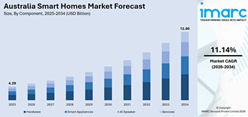
The Australia smart homes market size was valued at USD 4.29 Billion in 2025 and is projected to reach USD 12.80 Billion by 2034, growing at a compound annual growth rate of 11.14% from 2026-2034. The increasing consumer preference for connected and convenient lifestyles; strong government support for energy-efficient residential technologies and expanding digital infrastructure; and the growing adoption of AI-driven, voice-controlled home automation solutions are among the key factors propelling the Australia smart homes market forward.
How AI is Reshaping the Future of Australia Smart Homes Market
Artificial intelligence is fundamentally redefining the Australian smart homes landscape, transforming connected devices from simple remote-controlled gadgets into intelligent, self-learning systems that anticipate household needs and optimize residential environments autonomously. AI-powered platforms are enabling smart homes to learn occupant routines, automatically adjusting lighting, temperature, and security settings to maximize comfort and energy efficiency without manual intervention. The integration of generative AI and natural language processing into home automation platforms is creating more conversational, context-aware interfaces that understand complex commands and deliver personalized experiences. Key AI applications reshaping the smart homes market include:
Request a Business Sample Report for Procurement & Investment Evaluation:
https://www.imarcgroup.com/australia-smart-homes-market/requestsample
Australia Smart Homes Market Trends
Growing Adoption of Voice-Controlled and AI-Powered Smart Systems
Voice-activated devices have become central to home automation in Australia, enabling residents to control lighting, entertainment, security, and climate systems through natural speech commands. As of March 2024, approximately 40% of Australian households own a Google Home smart speaker and 31% include an Amazon Echo device, reflecting the strong consumer embrace of voice-enabled control systems that serve as hubs for broader smart home automation. The increased accuracy of voice recognition technologies and seamless integration across multiple smart platforms have made these interfaces highly appealing to mainstream consumers who previously found home automation intimidating or overly technical. Google’s announcement of ‘Gemini for Home,’ set to replace Google Assistant with more conversational and context-aware voice control capabilities, signals a significant leap in how Australians will interact with connected devices. Australian households are increasingly viewing voice control as the simplest and most accessible gateway into broader smart home ecosystems, with adoption expected to deepen further as natural language processing capabilities advance and multi-device interoperability improves.
Energy Efficiency and Sustainable Smart Living Solutions
Environmental consciousness and rising utility costs are driving Australian homeowners to invest significantly in smart energy management technologies that deliver both ecological and financial benefits. Intelligent thermostats, solar integration platforms, automated lighting systems, and smart appliances enable households to monitor and minimize energy consumption with unprecedented precision. The Australian Government’s ‘Solar Sharer’ programme, under which energy retailers will be required to offer households with smart meters at least three hours of free solar-generated electricity during midday starting in 2026, is directly encouraging consumers to adopt smart home devices that can shift demand to periods of abundant renewable energy. Additionally, the Australian Renewable Energy Agency (ARENA) and SA Power Networks launched the Energy Masters project in 2024, installing home energy management systems and smart appliances in 500 South Australian homes to optimize energy use and demonstrate the value of coordinated residential energy flexibility. The alignment of smart home technologies with Australia’s broader sustainability goals is making energy management one of the most compelling value propositions in the residential market, attracting both environmentally aware consumers and cost-conscious households seeking long-term utility savings.
Australia Smart Homes Market Summary
Australia Smart Homes Market Growth Drivers
Rising Consumer Preference for Connected and Convenient Lifestyles
The growing desire for seamless, automated living experiences is serving as a powerful and enduring driver of smart home adoption across Australia. Consumers increasingly expect their residences to respond intelligently to their routines, preferences, and schedules without constant manual input. The proliferation of smartphones and wearable devices has cultivated a generation of digitally connected individuals who naturally gravitate toward home automation as an extension of their digital lifestyle. Voice assistants, mobile applications, and centralized control platforms allow Australians to manage lighting, entertainment, security, and climate settings remotely and intuitively. The cultural shift toward convenience-first living is creating sustained momentum for smart home investment across diverse household demographics, from young professionals in urban apartments to families in suburban homes. New residential constructions are increasingly incorporating smart-ready infrastructure as a standard feature, embedding automation capabilities into Australian housing from the ground up and further normalizing connected living as the default residential experience.
Australia Smart Homes Market Segments
Breakup by Component:
Breakup by Application:
Breakup by Region:
Australia Smart Homes Market Latest News & Development
𝗔𝗯𝗼𝘂𝘁 𝗨𝘀
IMARC Group is a global management consulting firm that helps the world’s most ambitious changemakers to create a lasting impact. The company provide a comprehensive suite of market entry and expansion services. IMARC offerings include thorough market assessment, feasibility studies, company incorporation assistance, factory setup support, regulatory approvals and licensing navigation, branding, marketing and sales strategies, competitive landscape and benchmarking analyses, pricing and cost research, and procurement research.
𝗖𝗼𝗻𝘁𝗮𝗰𝘁 𝗨𝘀
IMARC Group
134 N 4th St. Brooklyn, NY 11249, USA
Email: [email protected]
Tel No: (D) +91 120 433 0800
United States: +1-201-971-6302
United Kingdom: +44-753-714-6104

© 2025 Crivva - Hosted by Airy Hosting Managed Website Hosting.