


Artificial Intelligence (AI) has rapidly evolved from a niche technological concept into a fundamental driver of modern business transformation. Organizations across industries are leveraging AI to automate operations, gain deeper insights from data, and deliver highly personalized customer experiences. However, adopting Artificial Intelligence for businesses is not as simple as implementing a few tools or hiring skilled AI developers. Without a clear roadmap, many companies struggle to achieve meaningful outcomes from their AI investments.
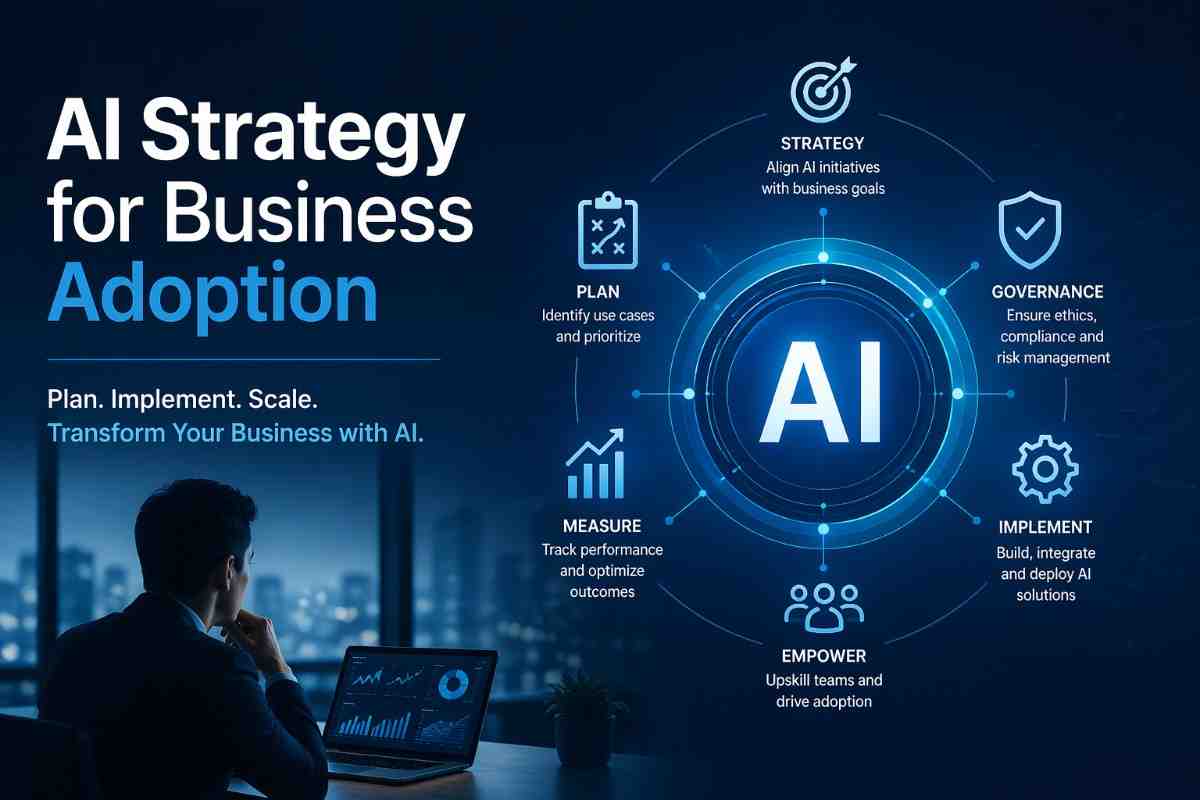
This is where a well-defined AI strategy plays a critical role. An AI strategy provides a structured framework that aligns AI initiatives with business goals, ensures efficient resource utilization, and enables scalable implementation. It transforms AI adoption from a fragmented effort into a cohesive, value-driven process.
In this comprehensive guide, we will explore how AI strategy helps businesses adopt artificial intelligence successfully, the key components of a robust strategy, challenges organizations face, and best practices to maximize ROI.
An AI strategy is a long-term plan that outlines how an organization will use artificial intelligence technologies to achieve its business objectives. It goes beyond technology selection and focuses on integrating AI into core business processes.
A strong AI strategy answers critical questions such as:
By addressing these questions, businesses can avoid random experimentation and instead focus on targeted, high-impact AI initiatives.
Artificial Intelligence for businesses is becoming essential due to increasing competition, data growth, and customer expectations. Companies that fail to adopt AI risk falling behind in efficiency, innovation, and market relevance.
AI enables businesses to:
However, these benefits can only be realized when AI adoption is guided by a well-structured strategy.
One of the most significant advantages of an AI strategy is its ability to align AI initiatives with business goals. Without alignment, organizations may invest in AI technologies that do not contribute to measurable outcomes.
For example, a company focused on customer retention may use AI for predictive analytics to identify churn risks, while a logistics company may prioritize route optimization. A strategic approach ensures that AI investments directly support business priorities.
AI strategy helps businesses identify and prioritize use cases that deliver the highest value. Instead of deploying AI across all areas simultaneously, organizations can focus on specific problems where AI can create immediate impact.
Common high-value use cases include:
By targeting these areas, businesses can achieve quick wins and build momentum for broader AI adoption.
A well-defined AI strategy provides a step-by-step roadmap for implementation. This roadmap typically includes:
This structured approach reduces uncertainty and ensures that AI projects are executed efficiently.
AI implementation requires investments in technology, infrastructure, and talent. Without proper planning, businesses may overspend or misallocate resources.
An AI strategy helps organizations:
This ensures that resources are used strategically to maximize returns.
Many organizations struggle to scale AI initiatives beyond pilot projects. An AI strategy addresses this challenge by focusing on scalability from the beginning.
Key elements of scalability include:
With a scalable approach, businesses can expand successful AI solutions across the organization.
The foundation of any AI strategy is a clear understanding of business objectives. Organizations must define what they want to achieve with AI and how success will be measured.
This involves setting specific, measurable, and realistic goals such as:
Data is the backbone of artificial intelligence. Without high-quality data, AI models cannot deliver accurate or reliable results.
A strong data strategy includes:
Businesses must ensure that their data infrastructure supports AI initiatives effectively.
Choosing the right technology stack is critical for successful AI adoption. This includes selecting appropriate tools, platforms, and frameworks.
Key considerations include:
Modern businesses often rely on cloud-based solutions to enable flexibility and cost efficiency.
AI developers play a vital role in implementing AI solutions. Their expertise is essential for designing, building, and deploying AI models.
Organizations need professionals with skills in:
Businesses can choose to build in-house teams, hire external experts, or partner with AI development companies.
Responsible AI adoption requires strong governance frameworks. Businesses must ensure that their AI systems are ethical, transparent, and compliant with regulations.
Key aspects include:
A well-defined governance structure builds trust among customers and stakeholders.
The demand for skilled AI developers often exceeds supply. This makes it challenging for businesses to build strong AI teams.
An AI strategy helps address this by:
Many organizations struggle with fragmented and inconsistent data. This limits the effectiveness of AI models.
A strategic approach focuses on:
AI projects can be expensive, especially during the initial stages. Without a clear strategy, businesses may waste resources on unsuccessful initiatives.
An AI strategy ensures:
Employees may resist adopting AI technologies due to fear of job displacement or lack of understanding.
A successful AI strategy includes change management initiatives such as:
Businesses should begin with small-scale pilot projects to test AI capabilities. These projects help identify potential challenges and refine the strategy.
Once successful, these initiatives can be scaled across the organization.
High-quality data is essential for accurate AI models. Organizations should invest in data management practices to ensure reliability.
Working with experienced AI developers and consultants can accelerate implementation and reduce risks. External expertise provides valuable insights and best practices.
Upskilling employees is critical for successful AI adoption. Training programs help teams understand how to work with AI tools and technologies.
AI is not a one-time implementation. Businesses must continuously evaluate performance and make improvements.
This includes:
The role of AI in business will continue to grow as technologies evolve. Organizations that invest in a strong AI strategy today will be better positioned to adapt to future advancements.
Emerging trends include:
Businesses that embrace these trends strategically will gain a significant competitive advantage.
Artificial Intelligence is transforming the way businesses operate, compete, and innovate. However, successful adoption requires more than just technolog, it demands a clear and well-structured AI strategy.
An effective AI strategy aligns AI initiatives with business goals, optimizes resource utilization, and ensures scalability. It helps organizations overcome challenges such as talent shortages, data issues, and high implementation costs.
By leveraging the expertise of skilled AI developers and focusing on high-impact use cases, businesses can unlock the full potential of Artificial Intelligence for businesses. Ultimately, a strong AI strategy turns AI from a technological experiment into a powerful driver of growth, efficiency, and long-term success.

© 2025 Crivva - Hosted by Airy Hosting Managed Website Hosting.








