If you’ve ever wondered whether 5G is really faster than 4G LTE or if you actually need 5G, you’re not alone. Many people see the 5G icon on their smartphones but are not completely sure what it means or how it improves their internet experience.
Over the past decade, 4G LTE has powered everything from mobile streaming to video calls and online gaming. Now, 5G technology is rapidly expanding. It promises faster speeds, lower latency, and better connectivity for everything from smartphones to smart cities.
So, what is the difference between 5G and 4G LTE, and does upgrading really matter?
In this guide, we’ll explain how 4G LTE works, what makes 5G different, the speed comparisons, real-world benefits, and whether switching to 5G is worth it for you.
4G LTE (Fourth Generation Long-Term Evolution) is the mobile network technology that most smartphones have used since the early 2010s. It replaced slower 3G networks and brought significant improvements in speed, reliability, and multimedia features.
4G LTE made it possible to:
Typical 4G LTE speeds range from 10 Mbps to 100 Mbps, depending on network coverage and congestion.
Due to its stability and wide coverage, 4G LTE still supports the majority of mobile internet connections around the world.
However, as more devices connect to the internet, such as smartphones, smart homes, cars, and IoT devices, networks need to change. That’s where 5G wireless technology comes in.
5G (Fifth Generation mobile network) is the latest development in wireless communication. It is designed to provide very fast internet speeds, ultra-low latency, and the ability to connect millions of devices at once.
Unlike previous generations, 5G networks use a combination of technologies, including:
These innovations allow 5G internet speeds to reach 1 Gbps or more in ideal conditions.
But speed isn’t the only advantage. 5G also reduces latency, which means devices communicate with servers almost instantly.
This makes 5G critical for technologies like:
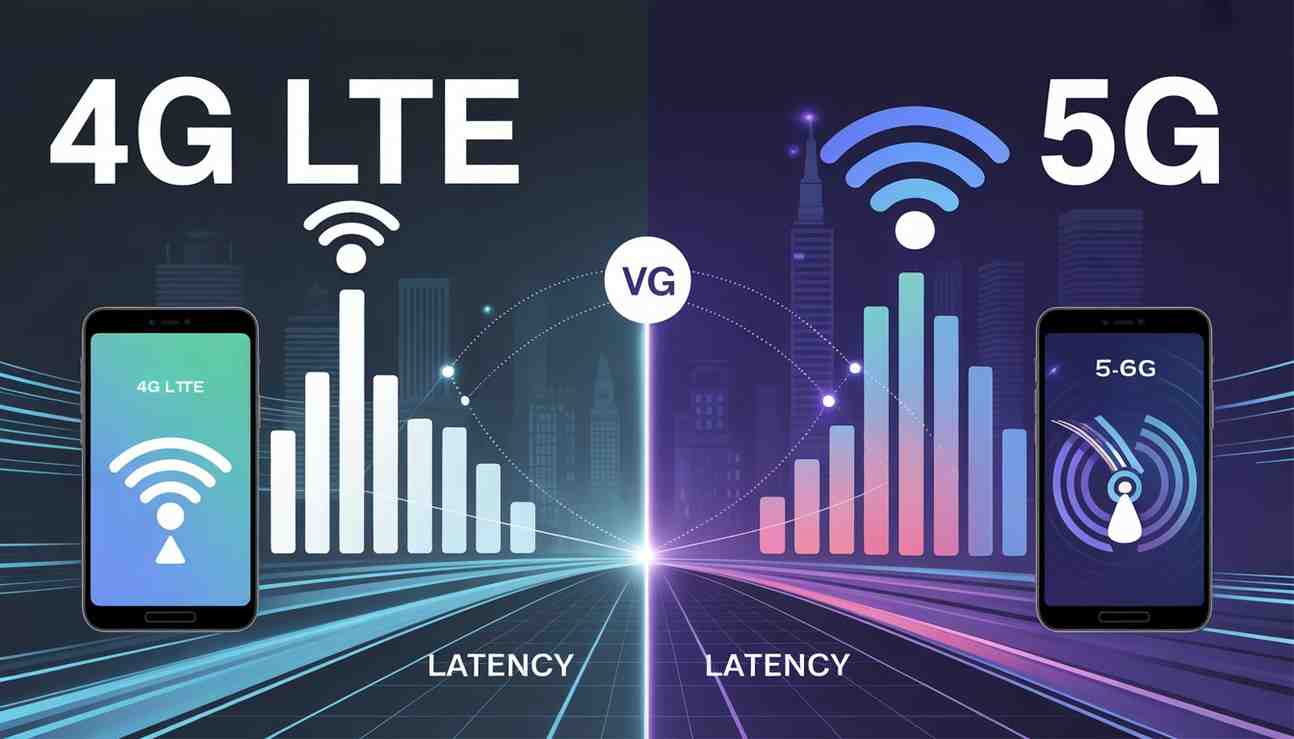
Although both networks serve the same purpose of delivering wireless internet, the differences between 5G and 4G LTE show that their capabilities vary significantly.
One of the biggest differences between 5G vs 4G LTE is speed.
4G LTE Speed:
5G Speed:
This means downloads that take minutes on 4G LTE could take seconds on 5G.
For example:
Latency refers to how quickly data travels between devices and servers.
4G LTE latency: around 30–50 milliseconds
5G latency: as low as 1–10 milliseconds
Lower latency is crucial for applications that require real-time response, such as:
As more devices connect to networks, congestion becomes a challenge.
4G LTE networks can handle thousands of devices in a small area.
5G networks, however, are designed to handle millions of devices per square kilometer.
This is essential for smart cities, IoT devices, connected vehicles, and smart homes.
Despite its advantages, 4G LTE still has broader global coverage compared to 5G.
Because 5G uses higher-frequency signals, it often requires:
This means 5G coverage is expanding but still developing, especially in rural areas.
5G networks are designed to be more energy-efficient per bit of data transmitted.
This helps support:
While much of the conversation around 5G technology focuses on futuristic applications, it also improves everyday activities.
5G enables 4K and even 8K video streaming with minimal buffering.
Lower latency improves the quality of video meetings and online collaboration.
Cloud gaming services benefit from near-instant responsiveness.
Apps, movies, and updates download dramatically faster on 5G.
The real power of 5G networks goes beyond faster mobile phones.
Cities can connect sensors, traffic systems, and utilities to improve efficiency and safety.
Self-driving cars require instant data communication, which 5G enables.
Doctors can perform remote monitoring and telemedicine with minimal delay.
Factories can operate robotic systems and automated processes using real-time connectivity.
Switching to 5G smartphones depends on your needs and local network availability.
You may benefit from 5G if you:
However, 4G LTE remains perfectly capable for everyday internet usage like browsing, messaging, and social media.
Many devices today support both 4G LTE and 5G, automatically switching depending on signal strength.
Although 5G offers impressive capabilities, there are still challenges slowing widespread adoption.
Building 5G networks requires thousands of new small-cell towers, which is expensive.
High-frequency millimeter wave signals travel shorter distances and struggle with obstacles like buildings and trees.
Older smartphones cannot access 5G networks.
The rollout of 5G wireless technology is still ongoing worldwide, but it represents a major step forward in digital connectivity.
Over the next decade, we can expect:
Eventually, 5G will become the new standard, just like 4G LTE replaced 3G networks.
The debate about 5G versus 4G LTE isn’t really about which one is better. It focuses on how technology evolves to meet increasing digital demands.
4G LTE is reliable, widely available, and fully capable for everyday mobile internet use. However, 5G offers faster speeds, greater capacity, and improved responsiveness. This technology will drive the next wave of digital innovation.
From quicker streaming and gaming to smart cities and self-driving cars, 5G is shaping the future of connectivity.
As network infrastructure grows and more devices become 5G compatible, it will slowly become the foundation of our connected world.
Yes, 5G is significantly faster than 4G LTE, offering speeds up to 10 times faster in many real-world scenarios.
Yes, you need a 5G-compatible smartphone to connect to a 5G network.
No, 4G LTE will continue to operate for many years, even as 5G expands globally.
Yes. Lower latency and faster speeds make 5G ideal for online gaming and cloud gaming services.
5G requires new infrastructure and more cell towers, so deployment is still ongoing worldwide.
Early 5G devices consumed more power, but modern smartphones are optimized for better battery efficiency when using 5G networks.

© 2025 Crivva - Hosted by Airy Hosting Managed Website Hosting.