

Quick Summary: The most profitable app types in 2026 are SaaS apps (highest revenue per user), food delivery apps (Uber Eats: $13.7B in 2024), on-demand service apps (TaskRabbit/Urban Company), short-video apps (TikTok: $4.4B in-app purchases in 2024), dating apps (Match Group: $3.5B in 2024), fintech apps, social media platforms, eCommerce apps, fitness/wellness apps, and EdTech apps. Subscription works best for B2B SaaS; commission + ads work best for marketplaces; in-app purchases dominate gaming and short-video. Most successful apps combine 2–3 monetization streams.
$613B
Global app revenue in 2024
$935B
Projected app revenue by 2028
258B
App downloads per year
92%
Mobile time spent inside apps
6.8B
Smartphone users globally
The four monetization models: (1) Subscription (recurring monthly/annual fees — best for SaaS, fitness, dating, content); (2) Commission/Marketplace (15–35% per transaction — best for food delivery, on-demand services, eCommerce); (3) In-App Purchases (digital goods, premium features — best for gaming, social, short-video); (4) Advertising (display + native ads — best for content-heavy apps with high DAU). Most successful apps combine 2–3 of these streams.
B2B · SUBSCRIPTION, $50–$500/user/mo
SaaS (Software-as-a-Service) apps consistently deliver the highest revenue per user of any app category — $50 to $500 per month per business customer, compounding over years. The global SaaS market crossed $300 billion in 2024 and is projected to exceed $1 trillion by 2030. Vertical SaaS (industry-specific tools for dentists, salons, contractors, manufacturers) is the fastest-growing sub-segment because incumbents like Salesforce don’t fit niche workflows.
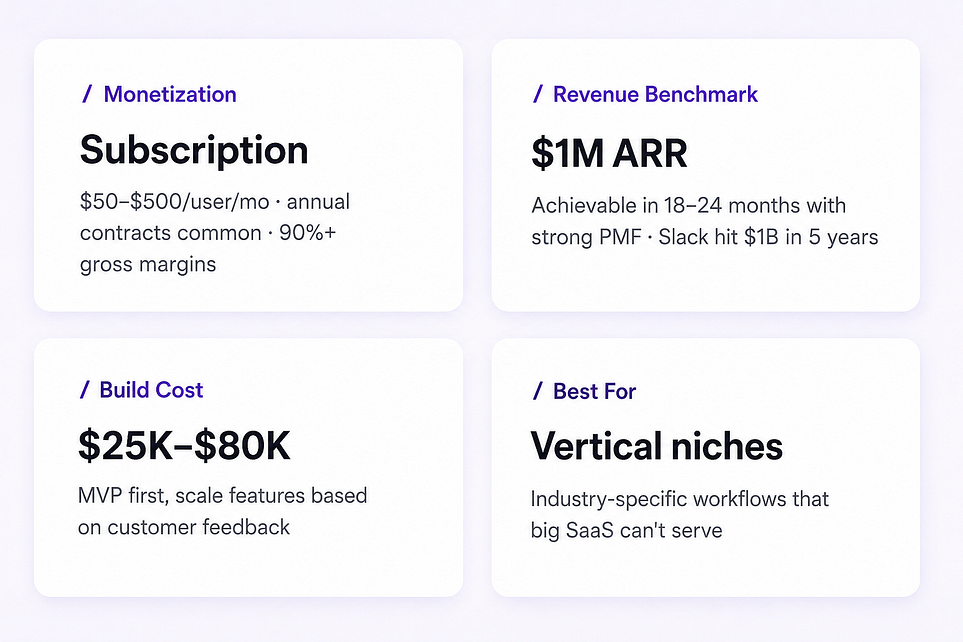
Slack ($1B+ ARR)
Notion ($500M+ ARR)
Figma ($600M+ ARR)
Linear ($50M+ ARR)
Calendly ($200M+ ARR)
Webflow ($200M+ ARR)
Why SaaS wins: Recurring revenue compounds. A SaaS customer paying $200/month for 3 years is worth $7,200 in lifetime value — versus a one-time $50 product sale. Vertical SaaS founders increasingly use AI features as their core differentiator in 2026: AI workflow automation, intelligent summaries, and predictive analytics are now table stakes. Most SaaS apps start as a web platform but quickly add native iOS and Android apps for engagement.
Food delivery remains one of the most reliable app categories for revenue in 2026. Uber Eats generated $13.7 billion in 2024, DoorDash hit $10.7 billion, and Zomato crossed ₹17,799 crore ($2.1B+) in revenue. The global food delivery market reached $1.2 trillion in 2024. The opportunity for new entrants isn’t competing globally — it’s owning a specific geography, cuisine, or vertical (cloud kitchens, B2B corporate meals, niche dietary apps).
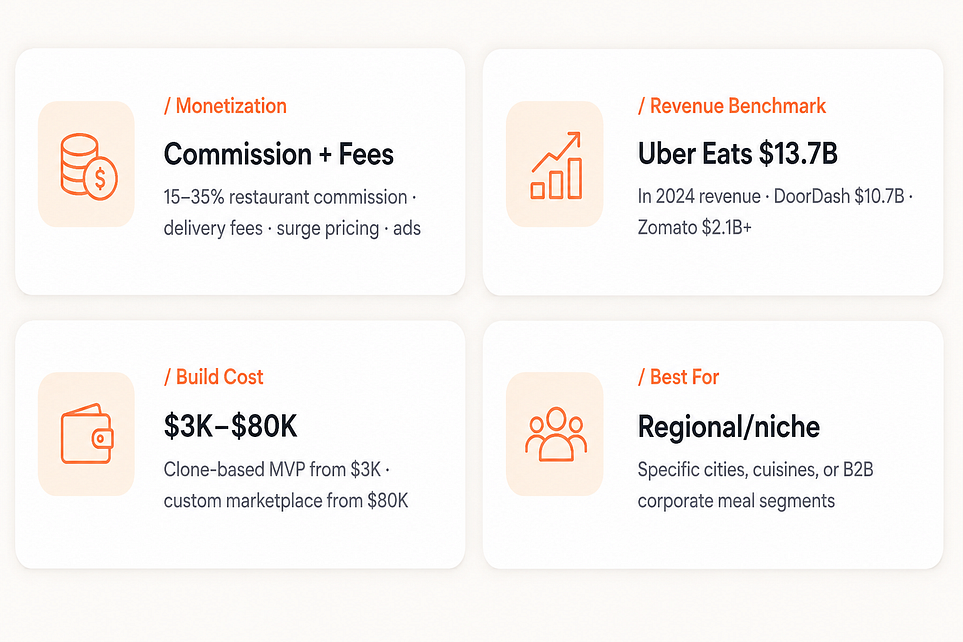
Uber Eats ($13.7B)
DoorDash ($10.7B)
Zomato ($2.1B+)
Swiggy ($1.5B+)
Grubhub ($1.6B)
Deliveroo ($2.4B)
Why food delivery wins (and warning): Predictable demand (people eat every day), 6 revenue streams baked in (commission, delivery fees, restaurant subscriptions, ads, surge pricing, cloud kitchen partnerships), and recurring usage that compounds. The warning: this is a thin-margin business that needs scale or a defensible niche. Don’t compete head-on with Uber Eats globally — own a vertical (vegan-only, halal-only, regional cuisine specific) or a city.
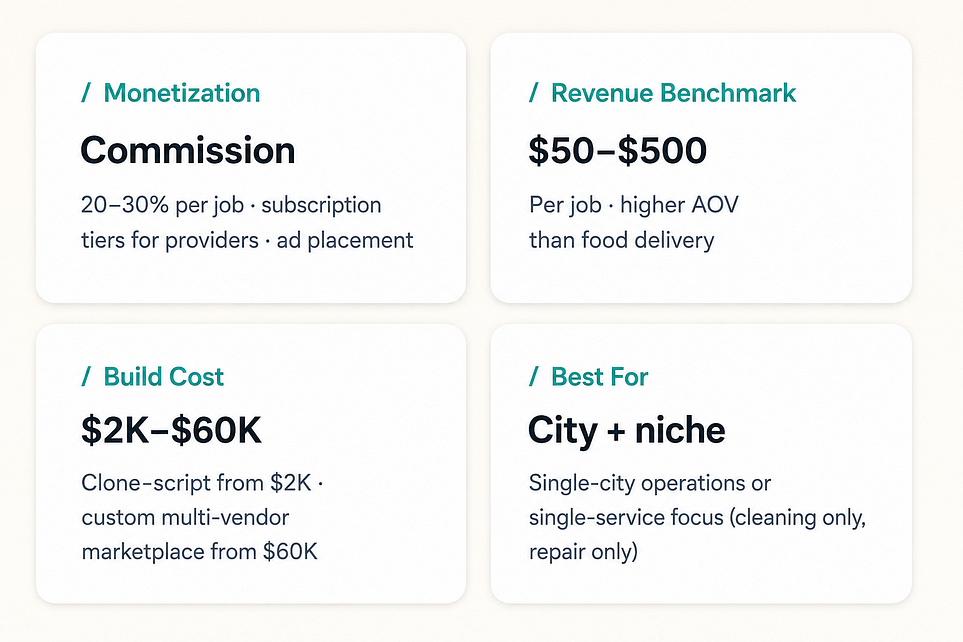
On-demand service apps — handyman, cleaning, beauty, repairs — generated over $2 billion in revenue in 2024 across TaskRabbit, Urban Company, Thumbtack, and Angi. The model is identical to food delivery (marketplace + commission) but with higher per-job ticket sizes ($50–$500 vs $20–$80 for food). Urban Company alone serves 7+ million users across 50+ cities. The opportunity for new founders is geographic (specific cities, specific service categories) or B2B (apps for property managers, real estate firms, hotels).
TaskRabbit (acquired $300M)
Urban Company ($600M+ rev)
Thumbtack ($350M+)
Angi/HomeAdvisor ($1.2B)
Handy
Bark
Care.com (acquired $500M)
Why on-demand services win: Higher per-transaction value than food delivery, recurring patterns (monthly cleaning, quarterly maintenance), and lower competitive intensity in most local markets. The barrier to entry is operational — you need to onboard, verify, and quality-control service providers — which is exactly what an app’s admin dashboard solves. HandyHue (built by Primocys) is a live handyman app on Google Play and the App Store demonstrating this exact model.
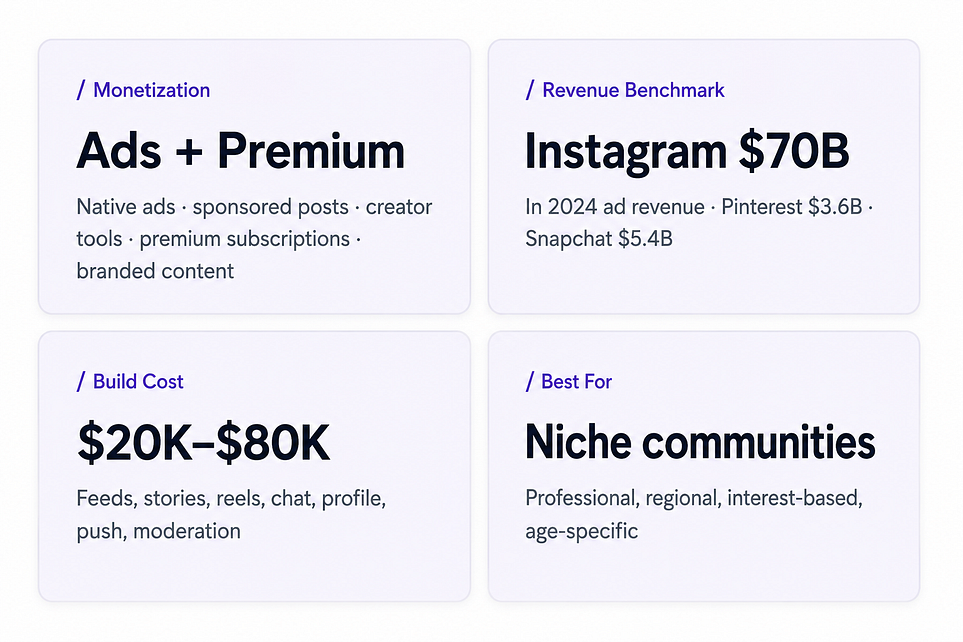
Social media generates massive revenue through ads, sponsored content, creator economy tools, and in-app purchases. Instagram alone generates over $70 billion in annual ad revenue. Pinterest crossed $3.6 billion. The opportunity in 2026 isn’t beating Instagram globally — it’s building niche social platforms for specific communities (artists, gamers, fitness enthusiasts, professional networks, regional networks, anonymous social, audio-only social). BeReal, Clubhouse, Lemon8, and many regional apps continue to prove this in 2026.
Instagram ($70B)
Pinterest ($3.6B)
Snapchat ($5.4B)
BeReal (acquired $500M)
LinkedIn ($16B+)
Reddit ($1.3B)
Lemon8
Why social media apps win (with warning): Network effects make winners take most — but niche social wins niche. Don’t build “the next Instagram” — build the Instagram for a specific community. NUVOGRAM, a social app built by Primocys, hit 10M+ posts indexed and 60FPS scrolling on mid-tier Android devices. The technical challenge is real-time feed performance and content moderation at scale.
Each app type has different revenue mechanics, build cost, and risk profile. Here’s a side-by-side comparison to help you find the model that matches your budget, market, and risk tolerance:
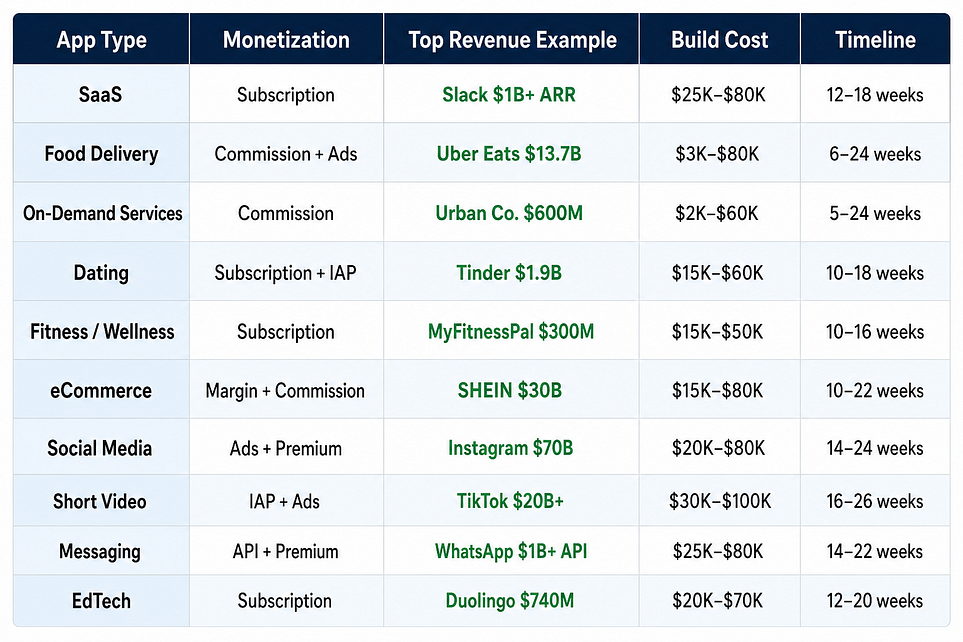
Bootstrapped founders should choose commission-based apps (food delivery, handyman) where revenue starts day one — or clone-script apps that launch in 5–10 weeks for $2K–$12K. Venture-backed founders can afford the long runway of SaaS or social network apps where revenue compounds slowly but defensibility is high.
If you need revenue within 3 months, build a clone-based handyman, food delivery, or dating app. If you have 12+ months of runway, build SaaS or vertical eCommerce. Don’t confuse “I want to build TikTok” with “I have a 5-year capital plan to build TikTok.”
The most successful app founders dominate a niche they understand intimately — a former chef builds the food delivery app for cloud kitchens, a former Salesforce admin builds the SaaS app for CRM-adjacent workflows, a former teacher builds the EdTech app for their specific subject. Generic horizontal apps lose to incumbents. Niche vertical apps win.
Across all 10 categories in this guide, the apps that make money consistently share three traits: (1) they solve a recurring problem (daily or weekly usage, not occasional), (2) they monetize behavior that already exists rather than creating new behavior, and (3) they own a niche before expanding to the broader market. Understanding these patterns is more valuable than chasing the “hottest” category.
App development costs in 2026 depend on three things: complexity, custom vs clone, and where you build. Indian development companies charge 60–70% less than US agencies for equivalent quality. Cross-platform development with Flutter cuts cost by another 30–40%. Here’s the real range:
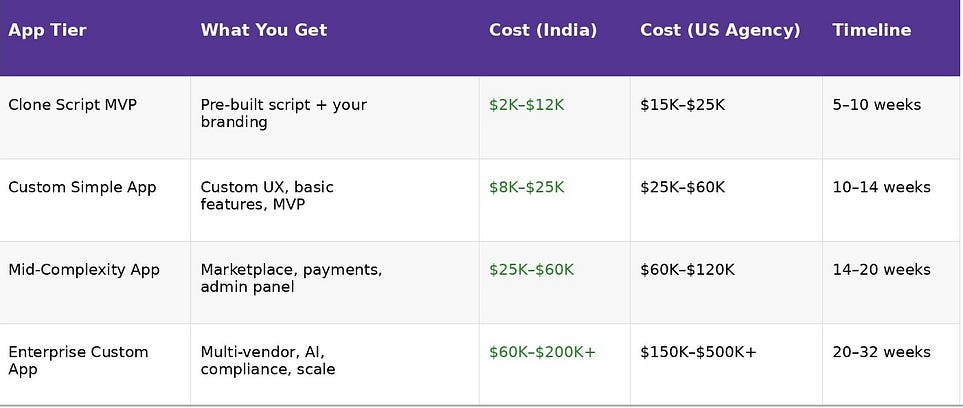
Why Indian development companies cost less: Senior developers in India bill at $25–$60/hour vs $100–$250/hour in the US — for equivalent technical quality. Primocys delivers apps at the higher end of Indian quality (Clutch Top Flutter Developer 2024 & 2026) at India pricing. Use our free app cost calculator to get a personalized estimate based on your specific app idea — no email required to start.
After breaking down all 10 types of apps that make money in 2026 — with real revenue figures, monetization models, and build costs — a few patterns stand out clearly for any founder or entrepreneur evaluating their next move.
First, the most profitable apps aren’t always the most downloaded. Google One, TikTok, and Tinder generate outsize revenue because they monetize deeply, not broadly. Revenue per user matters far more than raw download numbers — which is why SaaS apps at $200/user/month will always outperform a free app with 10 million installs but no monetization engine.
Second, when asking what type of apps make the most money, the honest answer is: it depends on your funding, timeline, and niche expertise. SaaS apps have the highest revenue per user. Food delivery and on-demand apps have the fastest path to commission revenue. Short-video and social apps have the highest ceiling — and the hardest floor. Dating and fitness apps sit in the sweet spot of strong willingness-to-pay and achievable niche differentiation.
Get a free 60-minute consultation with a senior solution architect. We’ll review your idea, propose a tech stack, and give you a fixed price + timeline within 48 hours — for any of the 10 app types in this guide.
Click Here: Book a Free Strategy Call →

© 2025 Crivva - Hosted by Airy Hosting Managed Website Hosting.