


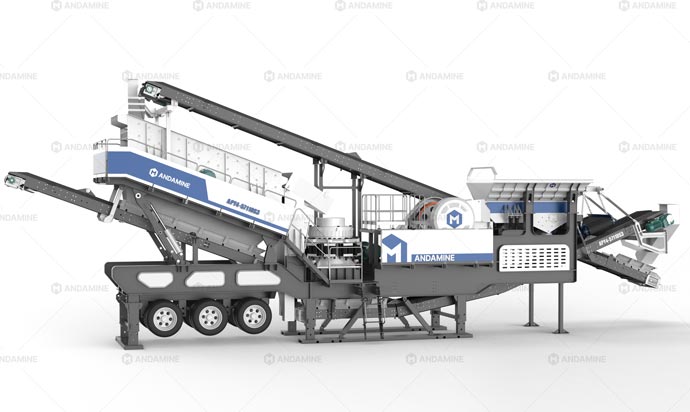
In the mining and aggregates industry, productivity is often equated with profitability. Many investors and contractors assume that a high-yield stone crusher plant automatically leads to better economic returns. However, the relationship between output capacity and overall cost efficiency is far more nuanced. Factors such as operational costs, material characteristics, equipment configuration, and project requirements all influence whether higher production truly translates into better profitability. This article explores whether high-yield crushing plants are necessarily more economical and how to make the right investment decision.
A high-yield stone crusher plant(planta trituradora de piedra) is generally designed to process a large volume of raw material within a given time frame. Instead of focusing only on hourly output, true high-yield performance also reflects how efficiently raw materials are converted into usable aggregates with minimal waste and downtime. In practical operations, yield is closely tied to the consistency of feed material, the stability of equipment performance, and the efficiency of screening and classification processes.
To achieve high throughput, these plants often adopt multi-stage crushing processes that include primary, secondary, and sometimes tertiary crushing. Larger crushers, high-capacity feeders, and integrated conveying systems work together to maintain a continuous material flow. In many modern projects, operators also incorporate a mobile stone crusher to enhance flexibility, especially when dealing with dispersed material sources or changing site conditions. While such configurations significantly improve productivity, they also increase system complexity.
A high-yield stone crusher plant typically requires a higher upfront investment compared to standard systems. This is mainly due to the need for larger equipment, more robust structural support, and advanced automation systems. Beyond the equipment itself, additional costs arise from installation, site preparation, and transportation. As a result, the total capital expenditure can be substantially higher, making it essential to evaluate whether the projected production volume justifies the investment.
Operating a high-capacity system introduces a different cost profile. Energy consumption tends to rise significantly, particularly when processing hard rock materials such as granite or basalt. At the same time, increased throughput accelerates wear on critical components, including crusher liners and screening media. This leads to more frequent maintenance cycles and higher replacement costs.
Although automation can streamline operations, it does not eliminate the need for skilled technicians. In fact, maintaining a high-yield plant often requires more specialized expertise to ensure optimal performance and to prevent costly downtime. These ongoing operational demands must be carefully balanced against the expected revenue from increased production.
High-yield plants are most effective in large-scale, long-term projects where consistent production demand exists. In such scenarios, the ability to process large volumes continuously allows operators to spread fixed costs over a greater output, effectively reducing the cost per ton. Over time, this scale advantage can significantly improve overall profitability, particularly in infrastructure or mining projects with stable demand.
The economic efficiency of a high-yield system depends heavily on a reliable supply of raw materials. When feed conditions remain consistent in terms of size, hardness, and moisture content, the plant can operate at or near its designed capacity. Under these circumstances, a stone crusher plant can deliver strong returns by maintaining high utilization rates. Conversely, interruptions in material supply can quickly reduce efficiency and increase unit costs.
Incorporating a mobile stone crusher(trituradora de piedra móvil) into the overall system can improve adaptability. Mobile units allow operators to respond to changing site conditions, reduce the need for material transportation, and handle multiple working faces more efficiently. This flexibility can enhance the economic performance of the entire operation, especially in projects with variable layouts or phased development.
In smaller or medium-sized projects, a high-yield plant may not operate at full capacity. This underutilization can lead to higher costs per ton, as the initial investment is not fully offset by production volume. In such cases, a more moderately sized stone crusher plant often provides better financial performance because it aligns more closely with actual demand.
Economic efficiency can also be undermined by external factors such as energy prices and maintenance conditions. In regions where electricity costs are high, the energy-intensive nature of high-capacity crushing can significantly increase operating expenses. Similarly, if spare parts are difficult to source or maintenance resources are limited, downtime may become more frequent, further reducing profitability.
Material characteristics play a critical role in determining whether high-yield operation is viable. Sticky or wet materials can disrupt material flow, while extremely hard or abrasive الصخور accelerate equipment wear. Variability in feed size can also reduce crushing efficiency and increase recirculation within the system. Under these conditions, attempting to maximize output may actually lead to lower overall efficiency.
Achieving economic efficiency requires careful alignment between plant capacity and actual production needs. Oversizing a system can result in unnecessary capital expenditure and higher idle costs, while undersizing may limit production potential. A well-matched stone crusher plant ensures that resources are utilized effectively without excessive investment.
Rather than focusing solely on increasing throughput, operators should prioritize process optimization. This includes selecting appropriate crusher types for each stage, improving screening efficiency, and reducing unnecessary material recirculation. In many cases, refining the process delivers greater economic benefits than simply increasing capacity.
Modern automation technologies provide valuable tools for improving plant efficiency. Real-time monitoring and intelligent control systems enable operators to adjust parameters quickly, maintain stable performance, and reduce energy consumption. When properly implemented, these technologies help high-yield plants achieve a better balance between productivity and cost.
A mobile stone crusher offers significant advantages in terms of mobility and ease of deployment. It can be quickly relocated between sites, making it particularly suitable for short-term projects or operations with changing work areas. The reduced need for extensive infrastructure also lowers initial setup costs, which can improve overall economic efficiency in certain scenarios.
Fixed high-yield plants are better suited for long-term operations with stable production requirements. Their design allows for higher capacity and more consistent performance, which can result in lower cost per ton when operating at full capacity. In these conditions, a fixed stone crusher plant often delivers superior long-term returns.
Many modern operations adopt a hybrid strategy that combines fixed and mobile systems. By integrating a high-capacity stationary line with one or more mobile stone crusher units, operators can achieve both high productivity and operational flexibility. This approach allows for better adaptation to varying site conditions while maintaining efficient large-scale production.
Before committing to a high-yield system, it is essential to evaluate project duration, material characteristics, and production requirements in a holistic manner. Budget considerations should extend beyond initial purchase costs to include long-term operational expenses. Local conditions, such as energy pricing and labor availability, also play a significant role in determining the overall economic outcome.
High-yield crushing plants can deliver strong economic performance when applied under the right conditions, particularly in large-scale projects with stable demand and consistent material supply. However, they are not universally the most cost-effective solution. When capacity exceeds actual needs or operating conditions are unfavorable, the financial advantages of high output can quickly diminish.
A more strategic approach involves balancing capacity, efficiency, and flexibility. In many cases, combining a properly sized stone crusher plant with a mobile stone crusher provides a more adaptable and economically sustainable solution. Ultimately, true profitability is achieved not by maximizing output alone, but by optimizing the entire production system to control costs and maintain consistent performance.

© 2025 Crivva - Hosted by Airy Hosting Managed Website Hosting.