

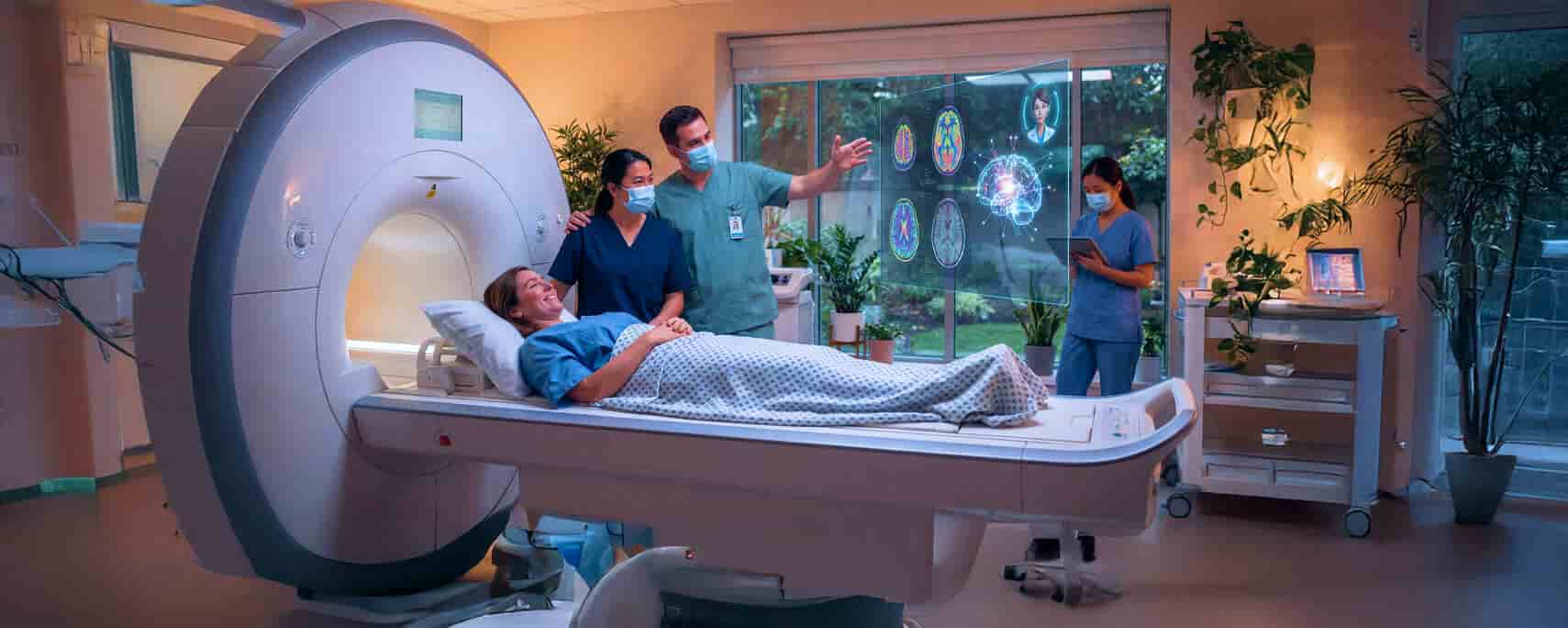
Radiology departments are facing unparalleled stress. Why? Escalating imaging volumes, growing case complexity, expectation of quicker turnaround time from radiology teams, and precision in outcomes – all these demands, frequently with disjoined systems and constrained personnel.
We are aware of how the initial discussions around AI in radiology emphasized image analysis – but the true change in shaping radiology is now occurring in a different area: radiology end-to-end workflows.
The main question is—how AI-driven workflow automation transforms radiology operations – that covers everything from patient appointment and examination scheduling to case prioritization, reporting, and outcome delivery.
When AI is integrated properly—it not only assists radiologists but helps change the outlook of the radiology department. It facilitates quicker diagnosis, operational effectiveness, and improved patient-centered care on a larger scale.
For AI to generate value, it must tackle the challenges that radiology teams encounter daily. Key challenges consist of:
Disjoined systems: PACS, RIS, and EHR platforms often operate in silos, forcing manual handoffs and duplicate data entry.
Reporting delays and manual case routing: Cases are manually assigned; urgent ones may not be prioritized immediately, and reporting processes continue to require considerable effort.
Radiologist exhaustion: Administrative demands, increasing workloads, and frequent context switching lead to fatigue.
Long turnaround times: Delayed reports impact downstream clinical decisions and adversely affect patient experience.
For CIOs, radiology directors, and operations leaders, the objective has evolved beyond merely AI-supported diagnosis to complete workflow transformation
AI in radiology has expanded beyond just image analysis algorithms. Currently, its most significant influence stems from coordinating the movement of work within the imaging ecosystem.
AI in the radiology workflow involves applying machine learning, automation, and smart coordination to enhance the scheduling, interpretation, reporting, and distribution of imaging studies throughout clinical systems.
This includes:
When AI is integrated throughout the workflow—not added as a separate tool—it becomes clinically applicable, operationally expandable, and trusted by healthcare teams
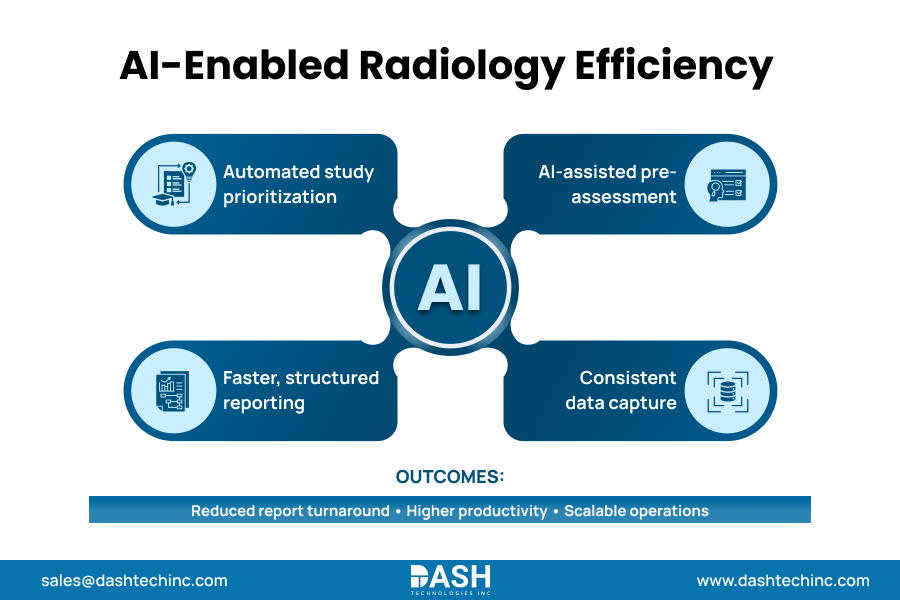
Improvements in radiology efficiency arise not from increased speed but from eliminating obstacles.
Automated study allocation: Imaging examinations are allocated in real-time according to urgency, type, subspecialty, and the availability of radiologists.
AI-driven pre-assessment: Key insights are highlighted promptly, guaranteeing that urgent cases prioritize the worklist.
Accelerated reporting via structured templates: AI-driven documentation shortens dictation duration and enhances report uniformity.
Uniform data collection: Automation reduces the need for redoing tasks due to absent or inconsistent data.
AI improves precision not by substituting radiologists—but by aiding superior decision-making in high-stress situations.
The outcome is a more secure, dependable diagnostic procedure—intended to enhance knowledge, not substitute it.
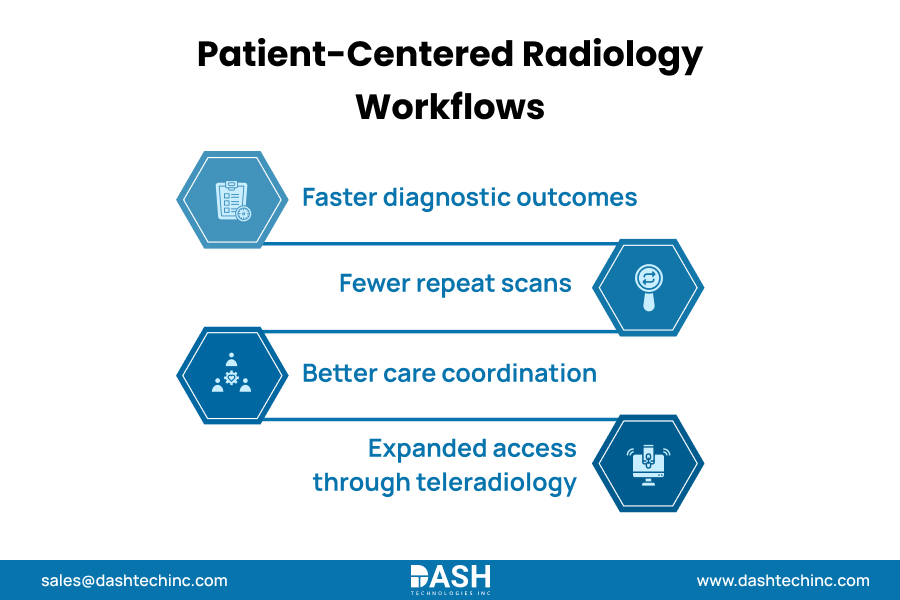
Radiology processes have a direct—and frequently undervalued—effect on patient experience.
When AI optimizes processes, patients gain advantages by:
Intelligent workflows enhance radiology teams’ ability to provide care that is timely, well-coordinated, and centered on the patient, reducing wait times and improving communication.
Automatically prioritizes stroke, trauma, and other critical findings for immediate review.
Dynamically assign studies based on urgency, modality, subspecialty, and resource availability.
Standardized templates accelerate documentation while supporting compliance and quality benchmarks.
AI-enabled orchestration across PACS, RIS, and EHR ensures seamless data flow and clinical visibility.
Predictive insights identify bottlenecks, forecast workloads, and optimize staffing and resource utilization.
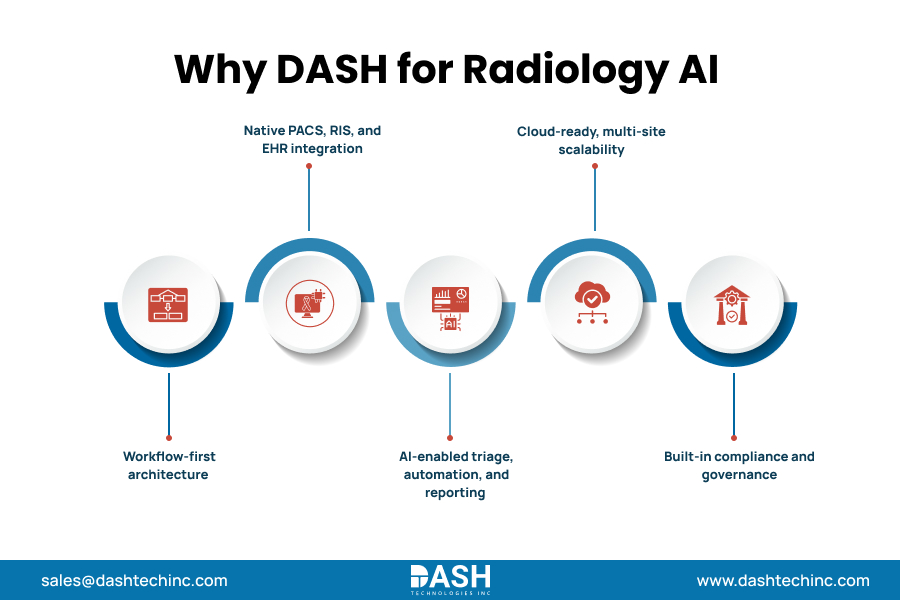
Dash approaches AI in radiology differently—workflow first, not algorithm first.
Our radiology workflow solutions are designed to make AI clinically usable by embedding intelligence directly into daily operations.
We don’t just implement AI—we engineer radiology workflows that allow AI to deliver real-world value.
Successful AI adoption requires more than technology.
Organizations that treat AI as a workflow strategy—not a software add-on—see faster ROI and stronger clinical alignment.
We all know that AI in radiology is no longer an option—but the true value merges when integrated into interoperable and intelligent workflows.
Healthcare organizations can achieve enhanced accuracy, faster diagnoses, reduced burnout, and improved patient-centered care
By transforming how imaging operations run end to end, healthcare organizations can achieve faster diagnoses, improved accuracy, reduced burnout, and more patient-centered care.
Ready to build AI-ready radiology workflows?
Explore how Dash’s Radiology Workflow Solutions can transform your imaging operations—or connect with our experts to design workflows that make AI work in the real world.
AI in radiology workflow refers to the use of artificial intelligence to automate and optimize end-to-end imaging processes, including exam scheduling, image acquisition, prioritization, analysis, reporting, and system integration. Instead of acting as isolated tools, AI solutions are embedded into daily workflows to support radiologists and care teams throughout the imaging lifecycle.
AI improves efficiency by automating repetitive tasks such as worklist prioritization, image triage, report structuring, and quality checks. It helps reduce manual effort, minimizes delays, shortens turnaround times, and enables radiologists to focus more on complex cases and clinical decision-making.
Yes, AI can enhance diagnostic accuracy by assisting with image analysis, detecting subtle abnormalities, reducing oversight errors, and providing decision support. AI models analyze large datasets consistently, helping radiologists identify findings earlier and with greater confidence, especially in high-volume imaging environments.
AI supports patient-centered care by accelerating diagnoses, reducing wait times, and improving communication across care teams. Faster and more accurate imaging insights enable timely treatment decisions, personalized care planning, and improved patient outcomes while reducing unnecessary follow-ups and repeat scans.

© 2025 Crivva - Hosted by Airy Hosting Managed Website Hosting.