Today’s hospitals are overwhelmed by data. Each ECG, lab test, prescription, radiology scan, and nursing note accumulates a flood of information. However, clinicians who require that data often struggle to obtain it fast enough to make informed decisions. Between EHR navigation, manual chart reviews, and frequent interruptions, nearly every clinical team reports some degree of cognitive overload.
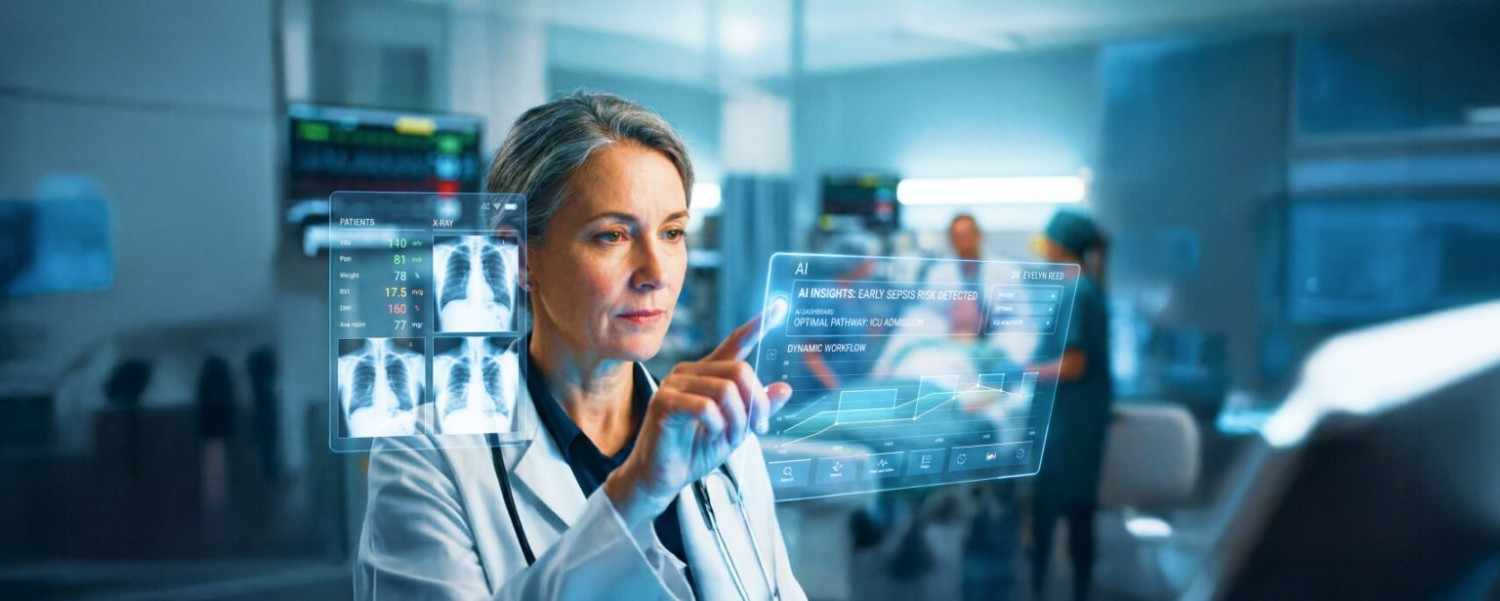
This gap between “data available” and “data usable” is exactly where AI-powered clinical dashboards are changing the game. These dashboards are not simply improved visual charts. They actively interpret data, surface what matters most, and remove countless friction points that slow down care teams. Rather than forcing clinicians to search for information, dashboards deliver context-rich insights at the moment they are needed.
The global AI in healthcare market increased from approximately $29.01 billion in 2024 to an estimated $39.25 billion in 2025, reflecting substantial investment in clinical AI tools. Predictive analytics—one of the core components of AI dashboards—has grown significantly as well, demonstrating increasing reliance on forecasting tools for deterioration detection, triage support, and operational planning. While adoption varies, large urban and multi-hospital systems report significantly higher AI utilization compared to smaller facilities. However, adoption alone does not guarantee success. Effective deployment requires validation, governance, and thoughtful workflow integration.
Healthcare workflow challenges rarely stem from a lack of information. Instead, the issue lies in fragmentation. Patient data is scattered across EHRs, imaging systems, bedside monitors, and operational platforms. Clinicians frequently jump between six to ten systems during a single encounter. They reconstruct patient histories from disconnected pieces, interpret numerous alerts, manage unpredictable patient volumes, and maintain compliance under mounting pressure.
AI-powered dashboards serve as a unified intelligence layer across these systems. They gather, clean, interpret, and present information in real time, reducing the cognitive burden on care teams. Rather than functioning as static reporting tools, these dashboards act as hospital-wide command centers.
AI dashboards combine real-time integration from EHRs, LIS, PACS, medical devices, and real-time location systems with advanced models that detect patterns, predict risks, and highlight anomalies. Unlike traditional dashboards that merely display data, AI-driven platforms interpret it. This distinction transforms them from passive tools into active decision-support systems.
One of the most significant problems AI dashboards address is excessive manual chart review. Clinicians often spend large portions of their day navigating patient records. AI dashboards consolidate the most relevant data into a single, prioritized snapshot. Instead of reviewing multiple screens, providers see a structured overview of vitals, lab values, imaging results, medication orders, and clinical notes in one place.
Operational visibility is another key improvement. When emergency department beds fill unexpectedly or lab processing times increase, downstream teams often discover the issue too late. AI dashboards continuously monitor operational patterns and flag bottlenecks early, allowing leaders to respond proactively rather than reactively.
Alert fatigue remains a widespread concern in healthcare. Many traditional alerts are generic and lack contextual prioritization. AI models analyze patient-specific risk factors and historical data to rank alerts by urgency and impact. This intelligent filtering reduces noise and ensures clinicians focus on what truly requires attention.
In emergency scenarios, speed and clarity are critical. AI dashboards enhance triage and crisis management by providing real-time, context-aware insights. Emergency departments can evaluate presenting symptoms, vital sign trends, risk scores, bed availability, and waiting room loads in a unified interface. This enables faster prioritization and improved patient flow.
Intensive care units also benefit significantly. AI systems surface early deterioration patterns that may otherwise go unnoticed during busy shifts. Subtle changes in trends—such as shifts in oxygen saturation, blood pressure variability, or laboratory markers—are flagged early, supporting timely intervention.
Radiology departments use AI dashboards to flag stat cases, monitor modality wait times, track report turnaround delays, and prioritize studies based on clinical acuity. Instead of manually sorting cases, radiologists immediately see which studies require urgent attention.
Nursing workflows improve through intelligent task distribution. AI can recommend workload adjustments based on patient acuity, staff skill levels, current assignments, and unit census. This reduces communication delays and helps ensure equitable task distribution, minimizing burnout and missed responsibilities.
Interoperability forms the foundation of successful AI dashboards. Integration with EHR systems such as Epic, Cerner, Meditech, and Allscripts through standards like FHIR and HL7 ensures seamless data exchange. Dashboards also connect to imaging systems, lab information systems, medical devices, and real-time location platforms. The goal is not to replace existing systems, but to orchestrate them into a unified clinical view.
Data normalization and governance are critical to maintaining accuracy and compliance. Dashboards standardize data from multiple formats into consistent structures, ensuring reliability while adhering to strict security protocols. End-to-end encryption, role-based access controls, audit trails, and bias monitoring protect sensitive information and maintain regulatory compliance.
Hospitals implementing AI dashboards report measurable operational and clinical improvements. Emergency departments gain live visibility into patient flow and bottlenecks. ICUs reduce manual chart review time while improving early warning detection. Perioperative teams use predictive tools to anticipate case overruns and optimize scheduling. Bed management systems improve discharge forecasting and patient throughput.
Financial and operational benefits are equally significant. Reduced documentation burden contributes to lower clinician burnout. Improved resource allocation decreases delays and operational inefficiencies. Faster decision-making enhances patient safety in high-risk environments. Quality metrics such as length of stay, readmission rates, emergency department dwell time, and sepsis response times often show improvement.
Successful implementation requires a structured approach. Organizations must begin with workflow gap analysis to identify friction points. Clean, connected data must be established before layering AI capabilities. Dashboards should complement existing workflows rather than introduce unnecessary complexity. Short, role-based training sessions accelerate adoption. Clear performance indicators—such as reduced wait times, improved clinician satisfaction, and faster lab-to-action cycles—help measure success. Scaling should occur in phases, beginning with high-impact departments such as ICU, emergency care, or radiology.
Modern healthcare is moving toward insight-driven care. As patient acuity rises and staffing pressures increase, clinicians require tools that simplify decision-making rather than complicate it. AI-powered clinical dashboards transform overwhelming data streams into structured, actionable intelligence. By delivering real-time visibility, predictive insights, and workflow automation, they enable care teams to respond faster, reduce cognitive burden, and improve patient outcomes.
The future of healthcare will be defined not by how much data hospitals generate, but by how effectively they transform that data into clarity. AI-powered clinical dashboards represent a critical step in that evolution.