

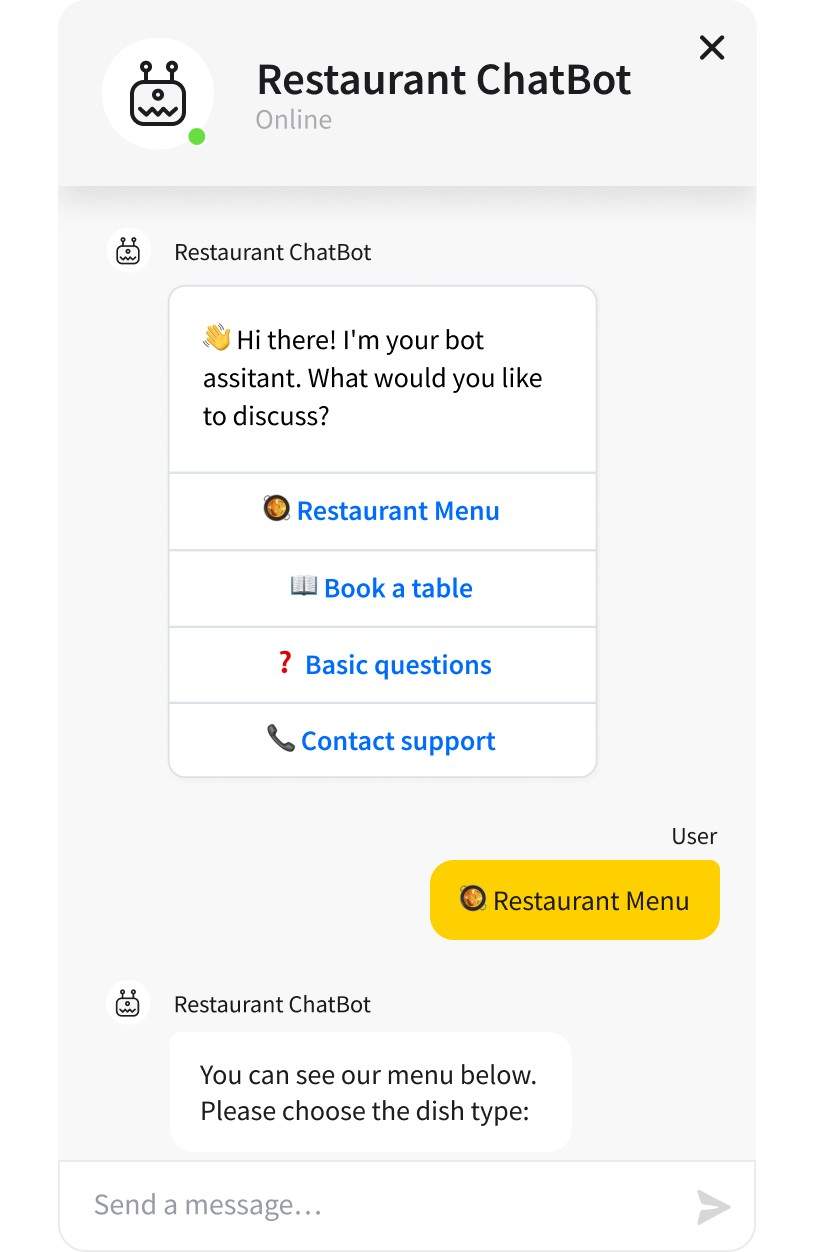
AI chatbots for food delivery are no longer experimental tools. They are revenue-generating, cost-reducing infrastructure for restaurants, virtual kitchens, and multi-location food brands competing in a high-demand digital market.
Customers expect instant answers, seamless checkout, real-time tracking, and personalized recommendations. Platforms such as Uber Eats and DoorDash have trained consumers to expect speed and convenience. Restaurants that fail to match that experience risk losing orders within seconds.
This comprehensive guide explains how AI chatbots for food delivery work, how they increase conversions, how they reduce operational costs, and how restaurants can implement them strategically for sustainable growth.
AI chatbots for food delivery are intelligent conversational systems designed to automate:
Online ordering
Menu inquiries
Allergen and dietary questions
Delivery tracking
Refund requests
Upselling and cross-selling
Loyalty program engagement
Unlike basic scripted chat widgets, modern AI chatbots use natural language processing (NLP), intent recognition, and contextual memory to understand what customers mean — not just what they type.
They act as digital ordering assistants that operate 24/7.
The food delivery landscape has become more competitive than ever. Rising labor costs, higher advertising expenses, and marketplace commissions have compressed margins.
Restaurants face several challenges:
High customer support volume
Order errors from manual entry
Cart abandonment
Limited staffing during peak hours
Inconsistent customer experience
AI chatbots address each of these challenges simultaneously.
Automation improves scalability without increasing payroll.
Food cravings do not follow business hours. AI chatbots allow customers to:
Browse menus
Customize meals
Reorder past favorites
Complete checkout instantly
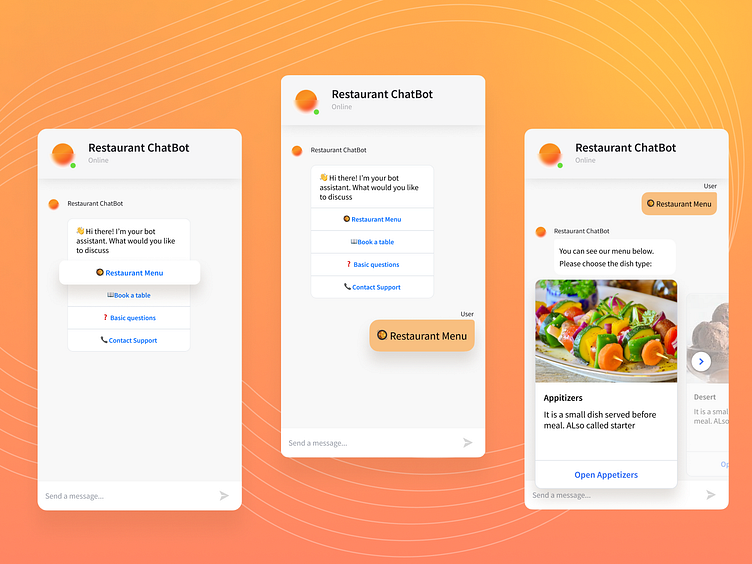

Always-on availability captures late-night orders and peak-hour demand without additional staffing costs.
AI chatbots analyze:
Previous purchase history
Time-of-day behavior
Popular item combinations
Seasonal preferences
Instead of generic promotions, they offer contextual recommendations:
“Add fries to complete your meal?”
“Customers often order dessert with this.”
These personalized prompts increase average order value by 15–30%.
Many customers abandon carts because they have unanswered questions:
“How long will delivery take?”
“Is this gluten-free?”
“Can I remove onions?”
AI chatbots provide instant clarification, reducing friction and improving checkout completion rates.
Voice commerce continues to expand through platforms like Google Assistant.
A significant percentage of inquiries involve repetitive questions:
Order tracking
Delivery updates
Address changes
Refund requests
AI chatbots can automate up to 70% of these interactions.
This reduces:
Support staffing needs
Training costs
Overtime expenses
Phone orders and manual entry often lead to mistakes.
AI chatbots confirm:
Item selection
Modifications
Delivery details
Payment confirmation
Structured ordering reduces refunds and food waste.
AI systems can:
Issue refunds automatically
Trigger compensation coupons
Escalate complex cases to human agents
Speed improves customer satisfaction and protects brand reputation.
| Feature | Traditional Support | AI Chatbot |
|---|---|---|
| Availability | Limited hours | 24/7 |
| Response Time | Minutes | Seconds |
| Scalability | Expensive | Scalable |
| Error Rate | Human error | Structured confirmation |
| Cost | High payroll | Lower operational cost |
AI chatbots for food delivery provide predictable scalability and consistent performance without rising labor expenses.
AI chatbots must be trained with structured data to minimize errors.
A restaurant knowledge base should include:
Menu items and pricing
Allergen details
Delivery zones
Refund policies
Promotions
FAQs
Proper training improves intent recognition and entity extraction, allowing the chatbot to understand complex orders such as:
“I want a large pepperoni pizza with no onions and extra cheese.”
Without structured training, mistakes increase.
Successful implementation requires integration with ordering systems.
Platforms like Shopify support chatbot integration for restaurants operating online stores.
Integration enables:
Real-time menu updates
Accurate pricing
Live inventory tracking
Secure payment processing
Disconnected systems reduce reliability.
Yes, but error rates decrease significantly when:
The chatbot is trained with structured menu data
Real-time system integration is enabled
Ongoing performance monitoring occurs
Human fallback workflows are configured
AI systems improve over time as more data is processed.
Restaurants implementing AI chatbots for food delivery often report:
10–25% higher conversion rates
15–30% increase in average order value
30–50% reduction in support costs
Faster issue resolution
Higher repeat purchase rates
Results depend on implementation quality and optimization strategy.
AI chatbots for food delivery are particularly effective for:
Multi-location restaurant chains
Cloud kitchens
Franchise operations
High-volume urban outlets
Automation ensures consistent service quality across all branches.
Location-based routing allows customers to order from the nearest branch automatically.
Retention is more profitable than acquisition.
AI chatbots support retention through:
Personalized promotions
Loyalty program reminders
Reorder suggestions
Post-delivery feedback collection
By maintaining continuous engagement, restaurants increase lifetime customer value.
A structured deployment plan includes:
Identify high-volume repetitive queries
Organize menu data into structured format
Train chatbot with custom knowledge base
Integrate with POS and payment systems
Test ordering flows
Monitor analytics and optimize
Restaurants looking for structured implementation often collaborate with providers such as Exotica AI Solutions to design AI systems aligned with long-term growth goals.
Conversational AI is not limited to food delivery. For example, a car dealership AI chatbot helps automotive businesses capture leads, answer financing questions, and schedule appointments.
This demonstrates the scalability of AI chatbot systems across industries.
Emerging trends include:
Predictive ordering based on behavior
Hyper-personalized promotions
Multilingual conversational systems
Advanced voice AI integration
AI-driven dynamic pricing
As machine learning advances, AI chatbots will become even more accurate and context-aware.
What are AI chatbots for food delivery?
They are AI-powered conversational systems that automate ordering, customer support, and engagement for restaurants and delivery brands.
How do AI chatbots increase restaurant orders?
They provide instant responses, personalized upselling, checkout guidance, and cart recovery automation.
Do AI chatbots reduce operational costs?
Yes. They automate repetitive customer inquiries and reduce staffing requirements.
Are AI chatbots suitable for small restaurants?
Yes. Even small operations benefit from 24/7 automated engagement and structured order confirmation.
Can AI chatbots replace human support entirely?
No. The most effective model combines AI automation with human escalation for complex cases.
AI chatbots for food delivery are no longer optional technology. They are core operational infrastructure for restaurants that want to increase orders, reduce costs, and compete effectively in a digital-first economy.
Automation improves efficiency. Personalization increases revenue. Integration ensures accuracy. Continuous optimization drives long-term growth.
Restaurants that implement conversational AI today gain a measurable competitive advantage — not just in efficiency, but in customer experience and profitability.

© 2025 Crivva - Hosted by Airy Hosting Managed Website Hosting.