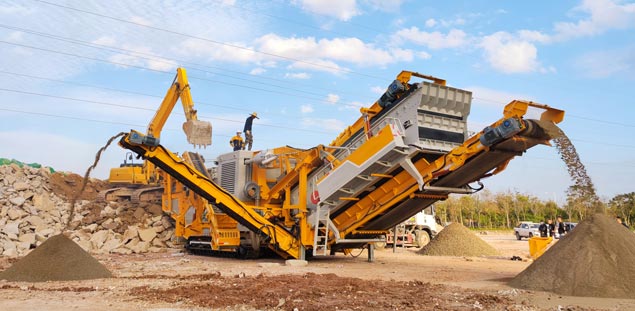
The efficiency of a high-capacity aggregate crusher plant is often judged by the power of its crushers, but the true secret to long-term profitability lies in the consistency of the material flow. In the demanding world of mineral processing, stability is synonymous with productivity. When material enters the system in irregular surges, it creates mechanical stress, reduces the quality of the final product, and leads to frequent unscheduled downtime. Whether you are operating a massive stationary facility or a compact mobile stone crusher plant, achieving a “choke-fed” condition—where the crushing chamber is kept consistently full—is the gold standard for operational excellence. This article explores the technical strategies and equipment configurations necessary to ensure that your production line remains balanced, predictable, and highly efficient.
Uniform feeding is the heartbeat of any aggregate crusher plant. It refers to the continuous and controlled delivery of raw materials into the crushing chamber at a rate that matches the machine’s processing capacity. When feeding is erratic, the crusher experiences “slugging,” where it is momentarily overloaded, followed by periods of “empty running.” Both extremes are detrimental to the health of the machinery and the bottom line of the business.
For operators using a mobile stone crusher plant, the stakes are even higher. Because mobile units often have smaller surge bins and more compact conveyors, there is less room for error. A sudden surge in material can quickly overwhelm the primary crusher, leading to blockages that require manual clearing—a dangerous and time-consuming task. Conversely, a stable feed ensures that the crushing liners wear evenly and that the particle shape remains cubical, which is essential for high-specification construction projects.
A rational aggregate crusher plant(planta de agregados) configuration begins with the feeder. The feeder’s job is to take the raw, unsorted material from the hopper and deliver it to the primary crusher in a steady stream.
The Vibrating Grizzly Feeder is the most common choice for primary stages. It performs two functions simultaneously: it moves the material forward and “scalps” the fines. By allowing smaller rocks and soil to bypass the primary crusher, the VGF reduces unnecessary wear and prevents the crusher from being “choked” by fine material that doesn’t need to be crushed. In a mobile stone crusher plant, the VGF is usually integrated directly into the chassis, making it a space-saving powerhouse.
If your aggregate crusher plant handles extremely heavy, wet, or abrasive materials (such as large basalt or granite boulders), an apron feeder might be more appropriate. These feeders consist of heavy-duty steel “pans” linked together like tank tracks. They provide exceptional torque and can handle high-impact loads that might damage a standard vibrating feeder.
One of the most effective ways to stabilize an aggregate crusher plant is to aim for a choke-fed state, particularly in secondary and tertiary cone crushers.
Choke feeding occurs when the crushing chamber is kept completely full of material. This creates a “rock-on-rock” crushing environment. Instead of the metal liners doing all the work, the stones crush against each other. This results in a better cubical shape, which is highly prized in the concrete and asphalt industries.
Maintaining a stable, full head of material in your aggregate crusher plant prevents the “bouncing” of the crusher head and reduces the shock loads on the bearings. In a mobile stone crusher plant(planta de trituración móvil), where vibrations can affect the stability of the entire platform, choke feeding is a critical factor in extending the life of the structural frame and the hydraulic systems.
In the modern era, relying solely on a manual operator to manage the feed rate of an aggregate crusher plant is no longer sufficient. High-tech sensors and automated control loops are now standard for top-tier operations.
By installing ultrasonic sensors above the crusher hopper, the system can monitor the material level in real-time. If the level drops too low, the automated system increases the speed of the feeder. If the hopper is nearly full, the system slows the feed down. This prevents both overloading and “no-load” running, ensuring that every kilowatt of electricity used by the aggregate crusher plant is translated into actual production.
VFDs allow the operator of a mobile stone crusher plant to adjust the speed of feeders and conveyors with extreme precision. Instead of a binary “on/off” approach, the VFD provides a smooth spectrum of speeds. This flexibility is vital when the moisture content or the hardness of the raw material changes throughout the day, allowing the system to adapt without stopping production.
Even with the best feeders, an aggregate crusher plant needs a “buffer” to handle the natural variations in quarry output. Surge bins act as a shock absorber between different stages of the crushing process.
Placing a surge bin between the primary and secondary crushers allows the secondary circuit to keep running even if the primary jaw crusher is momentarily stopped. This isolation ensures that the secondary and tertiary stages—the ones responsible for final product quality—maintain a stable, uninterrupted flow.
The stability of a mobile stone crusher plant is also affected by how material is stockpiled and reclaimed. If the loader operator picks up a bucket of “fines” followed by a bucket of “oversize,” the system will struggle to stabilize. Maintaining a consistent blend of material at the feed end is just as important as the mechanical settings of the aggregate crusher plant itself.
Stability is impossible to achieve if the machinery is in poor condition. A proactive maintenance schedule is the final pillar of a stable aggregate crusher plant.
Worn liners change the geometry of the crushing chamber, which in turn changes the throughput capacity. If the liners in your mobile stone crusher plant are unevenly worn, the material will flow faster on one side than the other, causing “eccentric” loading that can damage the main shaft.
Slipping or misaligned belts can cause material to spill or enter the next stage at an angle. For a high-output aggregate crusher plant, ensuring that all conveyors are properly tensioned and tracked is a simple but often overlooked aspect of stabilizing the production line.
Achieving uniform feeding is a continuous journey of optimization. As the quarry progresses and material characteristics evolve, your aggregate crusher plant must be flexible enough to adapt. By investing in high-quality feeders, implementing automated level controls, and prioritizing the choke-fed condition, you can transform a chaotic production line into a rhythmic, high-output operation.
For those operating a mobile stone crusher plant, the focus should remain on compact efficiency and the clever use of VFDs to manage limited space. Ultimately, the stability of the system determines the quality of the rock and the longevity of the machine. In the competitive landscape of 2026, the aggregate producer who masters the “art of the feed” will always be the one with the lowest cost per ton and the most satisfied clients. Consistent flow is not just an engineering goal; it is the foundation of a profitable and sustainable mineral processing business.

© 2025 Crivva - Hosted by Airy Hosting Managed Website Hosting.