

Moving an upright piano is not a one-person job, and it’s definitely not something you want to figure out as you go.
At 400 to 800 pounds, an upright piano is one of the heaviest and most awkward items in any home. One miscalculated step, a missed grip, or a tight doorway can mean a damaged instrument, scratched floors, or a serious injury. Most homeowners who decide to move their piano themselves run into the same problems: no proper equipment, not enough helping hands, and no clear plan of action. That’s where things go wrong fast.
This guide cuts straight to what you actually need to know. You’ll find every step laid out in order, from the tools to gather before you start, to navigating stairs and doorways, to loading the piano safely onto the truck.
Before you lift anything, know exactly what you’re dealing with. Upright pianos come in four sizes (spinet, console, studio, and upright grand) and their weight ranges from 300 pounds all the way up to 800. That difference matters enormously when it comes to how many people you need and what equipment to use.
Measure your piano’s height and width before mapping your route. A console might clear a standard doorway easily; a studio or upright grand might not. Knowing your piano’s size upfront saves you from costly surprises halfway through the move.
Having the right equipment before you start is non-negotiable. A piano dolly is essential; it’s specifically designed to handle the weight as well as shape of an upright piano (unlike a standard furniture dolly). You may also need moving straps or harnesses to keep the piano secure and distribute weight evenly across your crew.
Grab plenty of furniture blankets to protect the piano’s finish and your walls. Finally, keep packing tape as well as stretch wrap on hand to secure the blankets and prevent any shifting during transport.
You may need many. A lighter spinet or console piano requires a minimum of three people to move safely. A heavier studio or upright grand needs at least four, and five is better if stairs are involved. Assign roles before you start because nobody moves until everyone is ready and positioned correctly.
Avoid recruiting people who aren’t physically up for it. One weak line in the crew puts everyone (and the piano) at risk.
Before the piano moves an inch, prep it properly. Start by locking the keyboard lid. If it doesn’t lock, tape it shut with stretch wrap. Loose lids shift during the move and can cause serious damage.
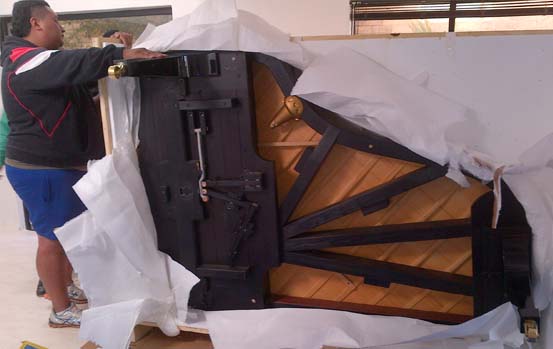
Wrap the entire piano in furniture blankets, paying extra attention to the corners. Secure the blankets tightly with packing tape or stretch wrap. Next, protect the pedals by wrapping them separately. For larger upright piano removal, removing the legs reduces both weight and bulk. Just make sure to label and bag every bolt so nothing gets lost.
Never start moving until you’ve walked the entire route first. Measure every doorway, hallway, and stairwell the piano needs to pass through. A standard upright needs at least 32 inches of clearance.
Identify tight corners early and figure out exactly how you’ll angle the piano through them. Remove any furniture, rugs, or obstacles along the path before the move begins. If the route involves stairs, walk it separately and plan that section in detail before moving day arrives.
This is where the actual work begins. Tilt the piano slightly backwards and slide the dolly firmly underneath; never rush this step. Make sure the piano sits centred on the dolly before anyone lets go. Move slowly and deliberately. One person calls direction while the others push and guide.
Never let the piano lean too far forward; it shifts the weight dangerously fast and becomes nearly impossible to control. At tight corners, stop completely, reposition, and then move again. Trying to muscle through a corner without stopping is how walls get scratched, pianos get dropped, and people get hurt.
Moving an upright piano yourself is absolutely doable, but only when every step is handled with care, the right equipment, and enough helping hands. Skip any part of the process, and you’re risking damage to your piano, your home, or someone on your crew.
If at any point the move feels too risky, too tight, or simply too heavy to manage safely, it’s best to trust that instinct and avoid potential damage or injury. This is exactly where Sydney Piano Removals can help. With over 20 years of hands-on experience, the team understands the complexities involved in moving delicate and valuable instruments like pianos. They use specialized equipment designed specifically for piano handling, ensuring maximum safety during every stage of the move. Fully insured for complete peace of mind, they provide reliable services across Sydney, the Central Coast, Wollongong, and the Blue Mountains. Their transparent, fixed pricing also means no hidden costs, making the entire process smooth, secure, and stress-free.
1. Can I move an upright piano by myself?
No, it’s not recommended. Upright pianos are heavy and require a couple of people and right equipment for secure shifting.
2. What gadget is needed to move an upright piano?
You need a piano dolly, shifting straps, blankets, and protective padding for secure dealing with.
3. Should I hire expert piano movers?
Yes, professionals make sure secure managing, prevent damage, and reduce the chance of damage during the move.
4. How much does it cost to move an upright piano?
Costs vary based on distance and difficulty, but local moves typically range from $200 to $500.
5. Can an upright piano be moved upstairs or downstairs?
Yes, but it requires experienced movers and proper equipment to handle stairs safely.
6. How should I prepare my piano before moving?
Clean it, secure the lid, remove loose items, and ensure clear pathways for safe movement.

© 2025 Crivva - Hosted by Airy Hosting Managed Website Hosting.