

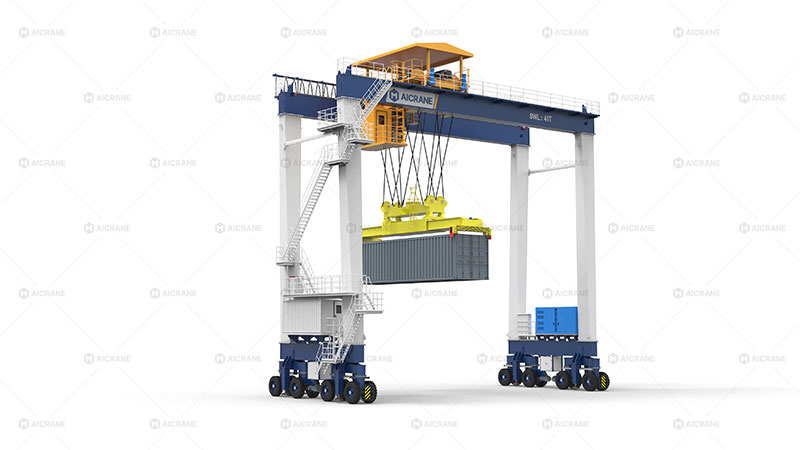
Container terminals are complex logistic hubs that rely on precision-engineered equipment to efficiently move containers between ships, trucks, trains, and storage yards. Among the most critical pieces of equipment in these terminals are container gantry cranes—specifically Rubber Tyred Gantry (RTG) cranes and Rail Mounted Gantry (RMG) cranes. Within these categories, configurations such as 1-over-3 and 1-over-5 refer to the number of containers the crane can span across the yard lane on the horizontal axis (in one direction) relative to its legs/frames. These configurations impact not just yard performance, but also significantly influence the manufacturing methodology of the cranes.
Understanding the manufacturing differences between 1-over-3 vs. 1-over-5 container handling gantry cranes is essential when selecting equipment tailored for operational needs, budget constraints, and long-term infrastructure planning.
1-over-3 configuration means the crane is designed to service three container lanes wide under its span. A typical 1-over-3 RTG or RMG will travel longitudinally along the yard, lifting containers over three adjacent lanes.
1-over-5 configuration means the crane can span five container lanes. This increases coverage, enabling the crane to reach farther without relocation.
Both configurations can be found in RTG and RMG variants, though the design requirements diverge due to mobility, foundation, and duty cycle differences.
The most significant manufacturing difference between 1-over-3 and 1-over-5 is span width:
1-over-3 cranes tend to have shorter spans, leading to lighter structural elements.
1-over-5 cranes require longer spans, demanding heavier and stronger girders and cross-bracing to maintain rigidity.
Because span increases with wider coverage, bending moments and structural stresses rise exponentially. This means:
1-over-5 cranes require thicker box girders, more extensive welding, and additional stiffeners.
Fin plate assemblies on main girders are much larger, increasing fabrication complexity.
The leg frames of 1-over-5 cranes are often taller or designed with different geometries to support the extended span while preserving clearance for traffic and container stacks.
Taller leg columns require precise machining and fabrication to avoid deformation.
For RMGs, foundations and rail alignments must tolerate these altered load paths.
Longer spans mean the crane will experience greater dynamic forces during acceleration, deceleration, and hoisting. This influences:
Selection of high-strength, low-alloy steels in critical members.
Use of finite element analysis (FEA) during design to verify stress distribution—a more intensive process for 1-over-5 cranes.
Both crane types require hoists and trolleys, but manufacturing differences emerge due to duty cycle and span:
1-over-3 cranes typically use standard capacity hoists suitable for regular container handling.
1-over-5 cranes may require dual hoist systems or multiple lifting units to maintain throughput over wider zones, especially in busy terminals. This adds:
More complex mechanical assemblies.
Additional gearboxes, cams, sheaves, and bearings.
RTG 1-over-5 cranes require more robust wheel assemblies and drive systems to handle the mass and inertia from the wider span and heavier trolley carriers.
RMG 1-over-5 cranes, with rail guidance, must be manufactured with precision track wheels, aligning carefully with rail tolerances for smooth operation.
Longer spans change the center of gravity (CG) and increase stopping distances.
1-over-5 cranes typically incorporate:
Redundant braking systems
Advanced anti-skid controls
More powerful drive motors
These systems are manufactured with higher performance tolerances and often include custom control algorithms.
The power needs for 1-over-5 cranes are higher due to increased mechanical demands.
1-over-3 configurations may be satisfied with conventional power distribution panels, busbars, and standard cable management systems.
1-over-5 configurations require larger electrical panels, enhanced insulation, and robust busbar systems to handle higher currents.
The control systems in wider span cranes must incorporate:
Load balancing
Anti-sway control
Integrated safety systems
Sometimes semi-autonomous or fully automated stacking solutions
This results in more complex manufacturing of:
Programmable Logic Controller (PLC) cabinets
Human-Machine Interface (HMI) consoles
Communication networks (often Ethernet or industrial fieldbus systems)
More sensor arrays and redundancy
1-over-5 main girders are significantly larger and heavier, requiring:
Larger gantry cranes in the fabrication shop
Specialized turning rolls and plate bending machines
Extended welding jigs and fixtures
1-over-3 cranes, while still large, fit within more standard fabrication workflows.
The larger structural members in 1-over-5 cranes necessitate:
Longer weld seams
More stringent Non-Destructive Testing (NDT) such as radiography or ultrasonic testing across larger areas
Additional heat treatment cycles to reduce residual stress
Because transporting very long spans can be logistically challenging:
1-over-5 cranes are often fabricated in modular sections (e.g., split girders) and assembled on-site. This requires:
More precision in shop fabrication
Additional field assembly labor
Enhanced dimensional control
Before delivery, both crane types undergo testing:
1-over-3 cranes are tested for basic load handling, travel functions, and safety components.
1-over-5 cranes require more rigorous testing:
Larger load testing
Full span dynamic load simulations
Interference testing across all 5 lanes
These tests are more time-consuming and often require special yard simulators.
The FAT process intensifies with wider span cranes, often including:
Full automation run tests
Integration tests with terminal operating systems (TOS)
Extended certification protocols
The complexity inherent in manufacturing 1-over-5 cranes translates directly into:
Larger structural sections, more motors, heavier electrical systems = more raw materials.
Longer fabrication times, higher skilled labor, and advanced testing procedures increase manufacturing costs.
Transportation of larger segments often requires special permits, escort vehicles, and coordinated schedules.
Due to additional design engineering, fabrication, and testing steps, lead times for 1-over-5 cranes are typically longer than for 1-over-3 configurations.
| Aspect | 1-over-3 Gantry Cranes | 1-over-5 Gantry Cranes |
|---|---|---|
| Span Width | Moderate | Very wide |
| Structural Complexity | Standard | High |
| Material Usage | Less | More |
| Hoist/Mechanical Systems | Standard | Enhanced/Dual |
| Electrical System | Standard | Larger & Complex |
| Control & Automation | Basic-Mid | Mid-Advanced |
| Fabrication Effort | Regular | Intensive |
| Testing & Commissioning | Moderate | Extensive |
| Cost | Lower | Higher |
| Lead Time | Shorter | Longer |
Choosing between 1-over-3 and 1-over-5 container gantry cranes isn’t just a matter of operational preference—it dictates profound differences in how the crane is manufactured, assembled, and delivered. From structural design to electrical systems, from fabrication to testing, the technological and logistical demands scale significantly when moving from a 1-over-3 to a 1-over-5 configuration.
For terminal operators, understanding these manufacturing differences is crucial—not only for upfront budgeting but also for long-term reliability, performance, and integration with yard workflows.

© 2025 Crivva - Hosted by Airy Hosting Managed Website Hosting.